Power Lines
Mercedes-Benz Art Collection in Dialogue with Central and Eastern European Art
Gábor Ébli
Ilona Németh: Eastern Sugar ╱ installation view ╱ Photo: Dániel Török
Next year will mark fifty years since the Stuttgart-based conglomerate, which celebrates its 140th anniversary this year, purchased its first work of art. Since the 1980s, the collection – initially known as the DaimlerChrysler Collection until the holding company’s restructuring – has been systematically expanded and now comprises some three thousand works by eight hundred artists.
Julika Rudelius: Double Surface ╱ 2025 ╱ Photo: Mercedes-Benz Art Collection
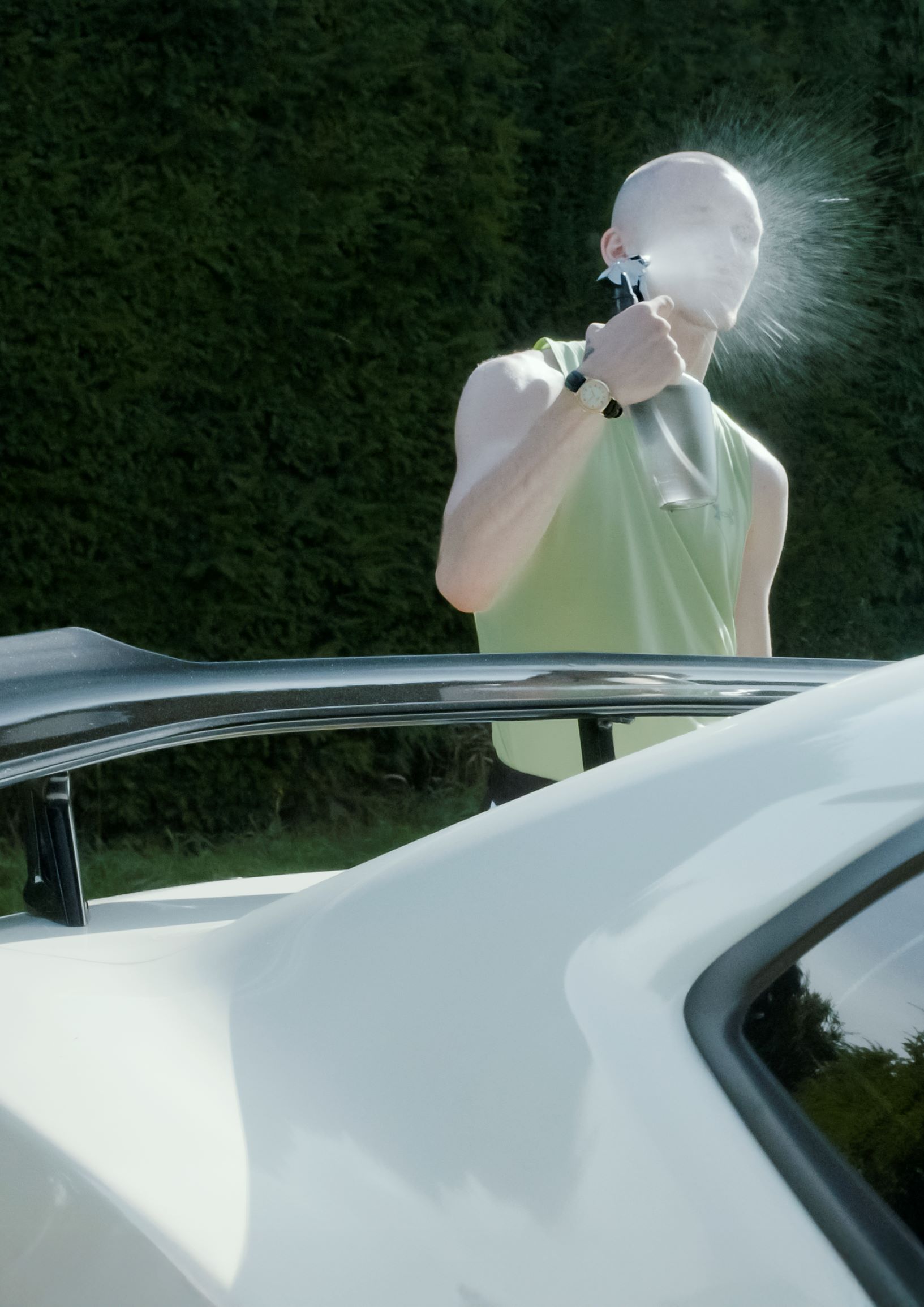
Julika Rudelius: Double Surface ╱ 2025 ╱ Photo: Mercedes-Benz Art Collection
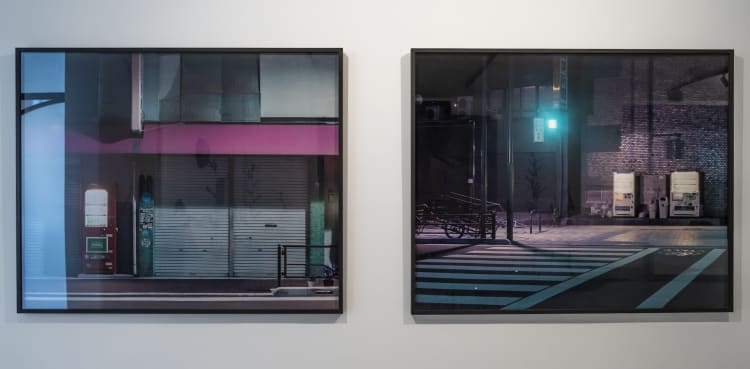
Benedikt Partenheimer: Vending machines #10 and #2, 2012 Photo: Dániel Török
The spectrum has broadened from a focus on predominantly German artists to a global scope. As the group is active in many parts of the world, exhibitions featuring selections from the collection have already been shown in numerous locations, from South Africa to Japan.
The Budapest exhibition fits into this series; the company is also present here through its Kecskemét site. A few Hungarian works have already been included in the collection. Two large-scale paintings by Imre Bak, one from 1969 and one from 2001, as well as a 2002 series of fourteen photographs by Attila Csörgő, were purchased in 2005 and featured in the bulky volume Minimalism and After, which showcased new acquisitions from 2000 to 2006.
Unlike the systematic focus on Eastern European art, as pursued by Vienna’s ERSTE Bank in the field of the neo-avant-garde or Bonn’s Deutsche Telekom in the field of contemporary art, Mercedes-Benz integrates art from this region into its globally diverse collection, with Polish artists being the most numerous from the region, ranging from Alicja Kwade to Monika Sosnowska.
Chronologically, the collection spans from the classical avant-garde to the latest contemporary trends without aiming to cover every era. Its stylistic and thematic focal points include geometric abstraction, discursive and socially activist art, as well as – in line with the company’s profile – motorisation and the artistic aspects of design.
From its initial panel paintings, the collection’s scope has expanded to include conceptual works on paper as much as a series of light installations that explore the extended meaning of vision. Alongside sculptures and objects, spatial art received emphasis when large-scale public works were commissioned from renowned artists for Stuttgart and later Berlin.
David Hockney: Steering wheel ╱ 1982 ╱ Photo: Mercedes-Benz Art Collection
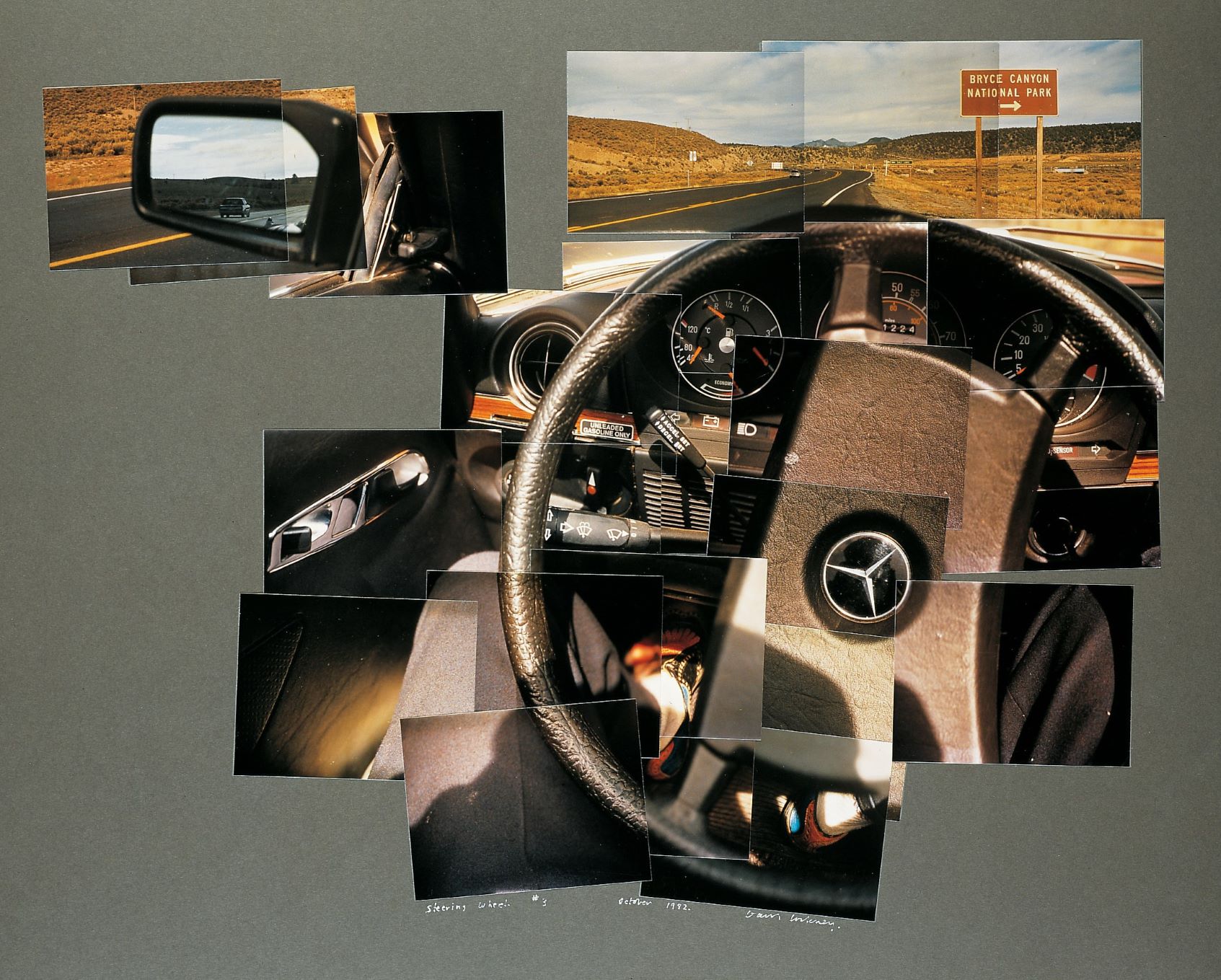
David Hockney: Steering wheel ╱ 1982 ╱ Photo: Mercedes-Benz Art Collection
The collection of new media dates back to the 1990s, and in the 2000s, the greats of international contemporary art, from John Armleder’s chandelier installation to Sylvie Fleury’s perfume bottle lightbox installation, were presented in several exhibitions. From our region, for example, Thea Gvetadze from Georgia, Dmitry Gutov from Russia, and Bojan Šarčević, a Serbian living in Berlin, are represented with works of this nature.
The photo-based material is particularly rich, ranging from Daniele Buetti’s fashion-critical shots through Kazuo Katase’s technically driven yet lyrical shadow fantasies to Guy Tillim’s series exploring poverty in Africa. The German section is the most extensive, ranging from Peter Roehr’s photomontages created from 1960s Mercedes advertisements to Andreas Schmid’s installation photographs from the turn of the millennium. Through the photo series by Vera Lossau, Verena Pfisterer and others, the collection also explores issues of the body.
Alongside socially engaged works, the collection also features photographs that explore aesthetic, and primarily compositional, issues, such as Oskar Schmidt’s series on the built environment or Uwe Seyl’s studio installations, which adopt a constructive approach and engage with the traditions of art history.
The versatility of photography is demonstrated by the fact that related themes can be interpreted in such diverse ways. Monika Brandmeier’s nine-part photographic series, created in 2000, documents abandoned, unfinished residential buildings near Bydgoszcz in northern Poland. These half-finished houses, devoid of windows and doors and thus unable to fulfil their intended function, can be perceived both as geometric sculptures and as social observations.
In the 1980s, Erwin Heerich first created geometric objects reminiscent of residential buildings on graph paper, and later in real natural environments. These minimalist pavilions, made from precisely dimensioned cardboard, were temporarily realised near the town of Neuss and can still be viewed today in Thomas Riehle’s photographs. The pavilions dreamlike combine (unrealistic) habitability with clean forms and the idea of concrete art. The company’s collection includes the original studio plans and models, as well as photos of the buildings taken in the Rhineland landscape.
Katalin Kortmann-Járay & Karina Mendreczky: Everything is illuminating ╱ 2026 ╱ Photo: Dániel Török
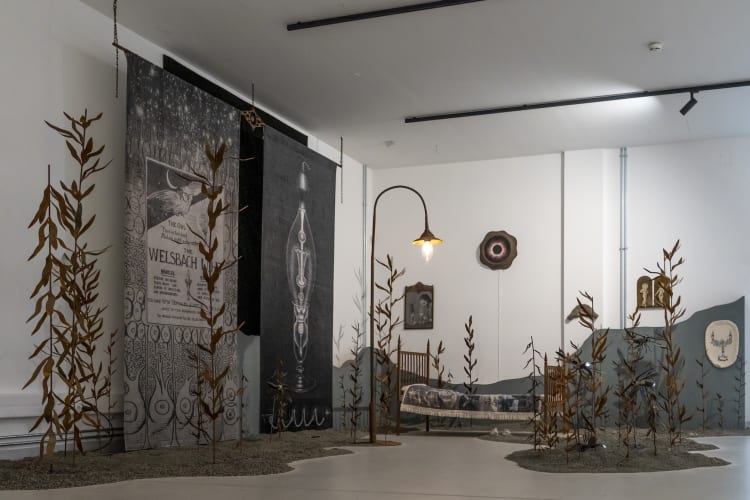
Katalin Kortmann-Járay & Karina Mendreczky: Everything is illuminating ╱ 2026 ╱ Photo: Dániel Török
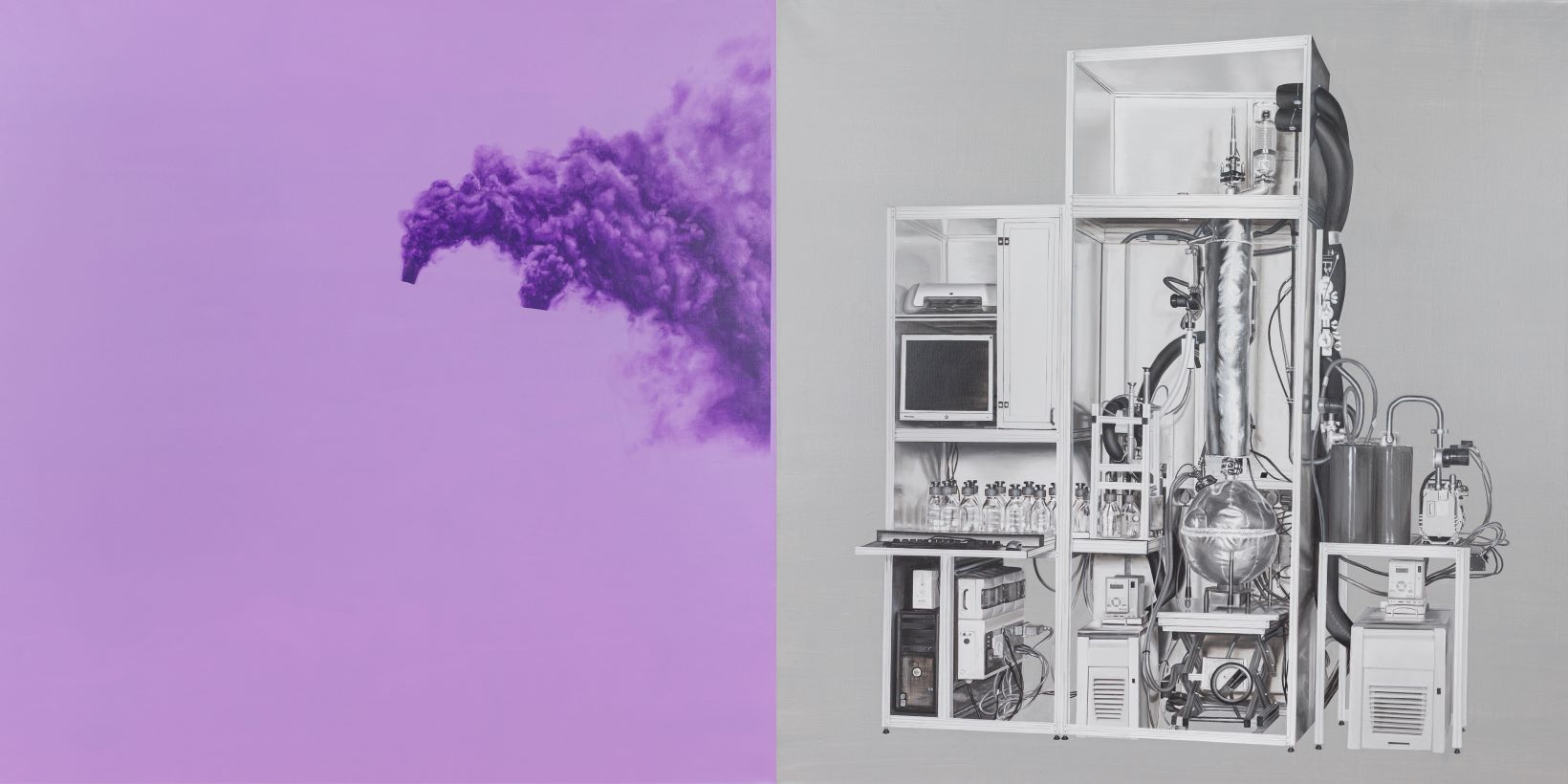
Rita Süveges: Twilight of petroleum ╱ 2021 ╱ Photo: A. Toěth
A third example is the series of photographs by the American artist Dan Graham. After the Second World War, prefabricated homes were built in several waves and in a variety of designs, first on Long Island and then in other parts of the country. The artist began photographing these in 1965 and created panels with accompanying texts from the photographs, titled Homes for America. The monotony and facelessness of these blocks, built for social purposes, convey a social message, whilst also allowing for a geometric, constructive aesthetic reading, as if the buildings had been deliberately placed side by side in the spirit of artistic seriality.
The key image of the Budapest exhibition, Benedikt Partenheimer’s photograph titled Vending machine 10 (Japan, 2012), can also be situated at the intersection of these two perspectives. The photo series was produced in Tokyo in 2013 with the company’s art scholarship. It reveals many specific details about the city through the central theme of vending machines, whilst the clarity of the images and the composition of the lighting conditions serve as a reference to the twentieth-century history of this approach to image-making.
It is this openness to multiple interpretations that gives strength also to the work of Santiago Sierra. We see ten identical, roughly one-metre-square sheets of plywood, painted snow-white. Ten human figures position, move and hold these in various poses. The relationship between the sheets and the figures creates a clear rhythm. Yet the faces of the figures – whose hands are protected by gloves and who are explicitly referred to as ‘workers’ in the title of the work – are not visible in a single photograph. What at first glance appears to be a minimalist performance turns out to be a metaphor for alienated, robotic wage labour. The medium of photography is essential to its message: this is how it is possible for the focus in every image to be on the impersonal gloves, whilst we do not see the faces of the subjects. In the world of commodity production, an individual’s identity is not their face, but the hand that performs the work.
The photo section also features numerous Chinese perspectives, ranging from analogue black-and-white series to works based on today’s digital mass culture. The impressions of China formed by an outside eye can also be linked to this, such as the photographs by German artist Thomas Struth documenting the transformation of Shanghai.
The curators – initially Renate Wiehager, and since the summer of 2023 Anne Vieth, both of whom are art historians with PhDs – are striving to include female artists in increasingly proportionate numbers. From the institution criticism of American artist Andrea Fraser,
to the self-portrait series by the Indian Pamela Singh – comprising uniquely coloured, originally black-and-white photographs that highlight the local Indian social context – some of the works are specifically female-themed. Other female artists engage with themes of geometry (Sarah Morris) or experimental use of materials (Leonor Antunes). In 2011, Anna Beöthy-Steiner’s (a Hungarian emigré artist who lived in Paris) abstract work featured in the she@Daimler.Art.Collection exhibition, and again in 2020 in the 31: Women exhibition.
Mercedes-Benz Museum ╱ Stuttgart ╱ Photo Mercedes-Benz
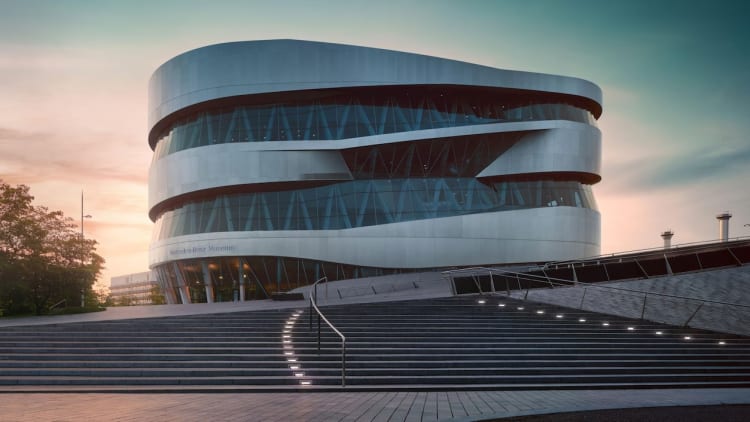
Mercedes-Benz Museum ╱ Stuttgart ╱ Photo Mercedes-Benz
Overall, as the company also funds awards and residency programmes for young artists, the programme integrates a museum-quality collection of art spanning the last hundred years, its active touring exhibitions, its publication in catalogues, and support for new works. This admittedly serves a marketing communication and CSR function: strengthening the company’s international image, fostering staff cohesion, and demonstrating its responsible social role to political decision-makers and the media. Equally valuable is its role in professional and artistic canonisation. Alongside museums and private collectors, this represents a third, institutional, corporate pole. The programme highlights this by organising a separate series entitled Private/Corporate, in which the corporate collection is presented in dialogue with private collections invited from various parts of the world, from Argentina to Israel.
Among the collection’s international exhibitions, the Budapest show is the second instalment of a new series. The version debuted in Mexico City in 2025, where the collection was presented in dialogue with works by local artists. The aim is for the collection’s exhibitions to thus directly engage the professional and wider audiences of each region. In keeping with this, the Budapest selection (curator: Krisztián Gábor Török, assistant curator: Gyöngyvirág Agócs) includes some thirty positions by artists and collectives from Central and Eastern Europe.
Roughly half of these are Hungarian works, such as the installation by Katalin Kortmann–Járay and Karina Mendreczky exploring the relationship between urban street lighting and the natural environment, or the relief carved from Corten steel by the duo known as Randomroutines (Tamás Kaszás and Krisztián Kristóf) titled Luddite Automation, which examines human labour.
The other half of the loaned works draws on the Eastern European region, ranging from the seven pyrography panel paintings by the Slovak duo Dávid Demjanovič and Jarmila Mitríková – depicting local archetypes on a monumental scale – to five paintings by the internationally renowned Romanian artist Șerban Savu. It is interesting to note that three of these five works have been loaned from private collections, including those of Ádám Kovács and Péter Küllői, which provides an informative insight into the history of the reception of these works.
The works brought from Stuttgart provide a balanced representation of the collection’s strengths. They include the artists already mentioned (Roehr, Sierra, Armleder, Fleury), as well as works by other major figures ranging from the American Robert Longo to the German Ben Willikens, including a photomontage by David Hockney. The British artist created this piece entitled Steering Wheel in 1982 by assembling a fictional steering wheel and a view from the driver’s seat using Mercedes advertising photographs. On the road stretching into the American distance, further vehicles can be seen both in the oncoming lane and in the rear-view mirror. The illusion of space seems complete. Yet the artist deliberately leaves the overall image, composed of mosaics, in a fragmented form. The steering wheel at the centre of the picture is a symbol of power and control, with which the driver keeps the engine’s power on the road and steers it in the right direction – but how surely?
The exhibition is organised around five themes (labour, energy, industry, modernism and ecology). Rather than separate blocks, these topics are interwoven. Likewise, international works from the collection are installed in dialogue with art from the region.
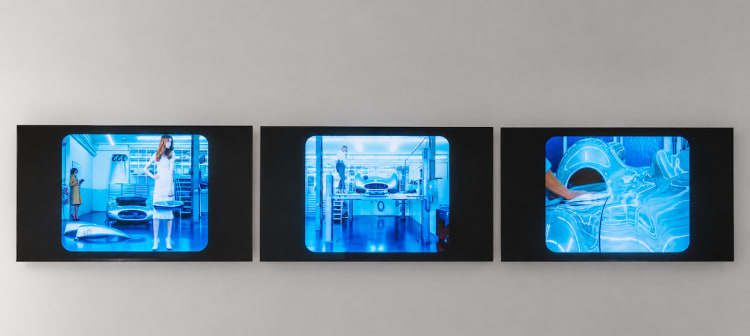
Sylvie Fleury: Swiss Polish Mediation ╱ 2005 ╱ Photo: Dániel Török
Berlin-based photographer Mustafah Abdulaziz researches global water scarcity and the unequal distribution of drinking water. From his series, the exhibition features a large-scale photograph of a luxury golf course built in the Californian desert. In the landscape bleached white by salt, lush green grass and a sparkling blue artificial lake await the elite.
Among the Eastern European works related to this theme, Rita Süveges’s hand-carved and hand-engraved bronze mirror fits perfectly here. The oil-stain-shaped mirror relief is placed on the floor; its title, Petrocene, alludes to the consequences of today’s world order, built on the excessive use of fossil fuels.
The dead ends of modernisation provide a recurring theme in the exhibition spread across Merlin’s two floors. This harmonises well with the building, which was once a transformer station. It was an ingenious curatorial decision to place pieces borrowed from Ágnes Eperjesi’s Busy Hands series – stamped art tiles depicting domestic labour – on the original tiles still preserved on the walls of Merlin’s former washroom.
The exhibition also makes striking use of elements associated with building renovation and industry, such as scaffolding, in other spaces. Photographic and video material from Ilona Németh’s project Eastern Sugar – which chronicles the history of sugar factories built in the Austro-Hungarian Empire, privatised after the fall of the Berlin Wall, and largely closed down since then – has also been borrowed, arriving with its complete storage system and installed alongside it. The sliding panels place the works within the context of the warehouse and the archive, meaning that they cannot all be seen at once; one always obscures the other. It is a barely concealed message that the whole story cannot be laid bare; we always experience only fragments of the (sugar factory) history. Németh’s empathetic photographs also present us with this insight into the factories that have lost their purpose, gaping emptily with crumbling walls, capturing the dignity of the built heritage in their slow decay.
The female perspective appears at numerous points throughout the exhibition. Selma Selman, who is of Bosnian origin and now works in her home country and in Amsterdam, uses car parts found in rubbish dumps or scrap yards by her family and other local communities out of necessity, including larger, intact pieces of bodywork, as the medium for her works, painting motifs of female vulnerability onto them, amongst other things. The cool male passion, driving, in the shape (of the wreck) of a branded car, meets the female testimony that has hitherto been pushed into the background. Among the objects, the curators have installed just a few on the wall, and perhaps this is where the most personal, metaphorical self-portrait lies: Selman has painted her bleeding finger, which she cut whilst working with metal.
Also featured in the exhibition from the company’s collection are the textile reliefs by Beijing-based Yin Xiuzhen. The works, which at first glance seem merely to employ exciting materials and, through their circular form and spiral shape, suggest the continuous, unstoppable transformation of the rolled-up textiles, take on a broader meaning when the deeply personal stories behind the garments used are revealed. The artistic upcycling of these former garments is a process of coming to terms with memories.
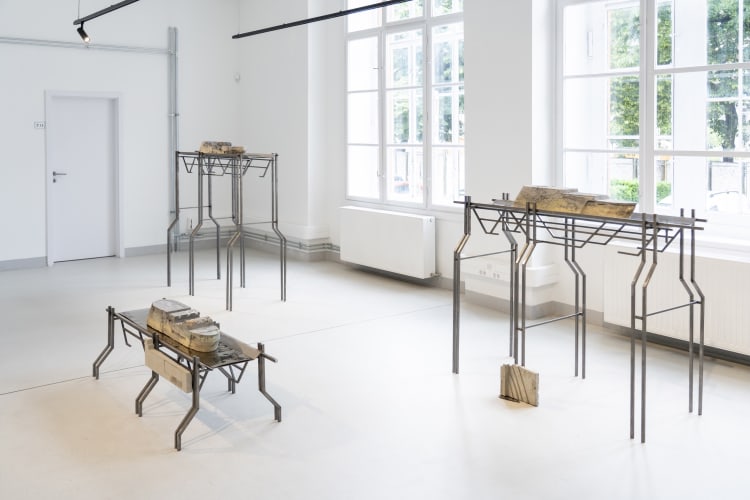
Works by Marta Dyachenko in the exhibition ╱ Photo: Dániel Török
Not quite what it seems – this is what gives the process of understanding its dynamism in the installation by Kosovar artist Doruntina Kastrati, which combines video and life-size objects. In the sequence of images, icing sugar falls idyllically, reminiscent of snow, onto the local confectionery factory’s pistachio-based speciality. We see the production process on the conveyor belt, and alongside the two-channel video, the giant form of the nut, shaped from cold metal, fills the space. It gradually becomes clear that the work focuses on the female workers, who literally stand on their feet through shifts, weeks, years, and a lifetime, their physical well-being sacrificed to the production of the sweets.
From the work by Ukrainian artist Marta Dyachenko – an object created from the rubble of a theatre in Kharkiv that was hit by a bomb during the current war – to Dániel Máté’s piece, which analyses labour and the flow of energy in relation to the human body by combining photographs and an installation, the exhibition is filled with works that adopt an experimental approach to art. This is particularly instructive in the context of corporate collecting in Hungary. A professionally ambitious corporate collection is no mere office decoration. The art programme of a profit-oriented large corporation is not an affirmative visual representation of consumer culture, but rather an engagement with discursive contemporary art.
The Art is Business platform played a key role in bringing the exhibition to fruition. At their invitation, the curator of the corporate collection came to Budapest three years ago to give a lecture on the subject of corporate art at the University of Fine Arts, and from there the current exhibition took shape in several stages. The aim is not for this to remain a one-off event, but for it to be followed by the presentation of further Western European corporate collections in Budapest, thereby setting an example for domestic companies as well.
The growth of corporate collecting – alongside the development of museums, independent art platforms, commercial galleries and other players – can help to promote the global integration of Central and Eastern European art. The current exhibition demonstrates that works from the region are on a par with other international works. But featuring in an exhibition is a different challenge from being included in a collection with a global scope. Although the exhibition was not titled Power Lines for this reason, the title describes the situation aptly. The art of Hungary, Eastern Europe or any other region not strategically prioritised can only move further along these lines of empowerment if the local institutional system – and, as part of that, corporate art patronage – raises its canonisation to a higher level.
▬▬▬▬
Merlin, Budapest
28 May – 30 August 2026