Future Blues
On András Szántó’s latest book
Patrick Tayler
“Your opinion matters!” – Amazon keeps nagging me to review this latest purchase of mine, András Szántó’s The Future of the Art World: 38 Dialogues (2025). If I buy into Curtis Yarvin’s spin on things, I’d better be typin’ – lest I upset my future techno-monarch, who will most likely hold power over my soul and the art world writ large. (I’m getting there, Sir Bezos!) With the post-war liberal consensus unravelling at the seams[1]– podcast by podcast, doomscroll by doomscroll, long past its peaceful bedtime hours prophesied by Francis Fukuyama – the art world might be in danger of “withdrawing into an amber grotto of splendid obscurity,”[2] a poetic string of words Szántó invokes to capture institutional-level escapism. This turbulent, unsettling future – one that the author approaches with professional, clear-eyed optimism – lies at the heart of the baby-blue book that recently landed on my doorstep.
Icon and cover image: The Future of the Art World: A Conversation, January 21, 2026. Photo: Ed Marshall © Solomon R. Guggenheim Foundation, New York.
The conversations gathered by Szántó resist any single vision of the future. Many of his interlocutors treat it less as a project to be shaped than as a condition to be anticipated – a shadowy dystopia to be navigated rather than transformed through modernist fervour and radical hope. Others, however, betray an almost accelerationist, techno-optimistic excitement, allowing the beams of scientific progress to illuminate new possibilities. According to this scenario, the future is little more than the present kicked into overdrive. It is precisely this coexistence of competing outlooks, rather than any unified thesis, that lends the volume particular value for anyone planning to inhabit the art world.
This plurality of visions is hardly accidental. Rather, it reflects a broader inquiry Szántó has pursued since the pandemic. In the author’s own conceptual framework, The Future of the Museum: 28 Dialogues (2020) provided the contemporary museum’s “software update,” while Imagining the Future Museum: 21 Dialogues with Architects (2022) investigated the “hardware” – the bricks, mortar and lush foliage that define these cultural hubs. The core dilemma throughout the trilogy has been how a museum might safeguard and activate art, “humanity’s most complex data.”[3] The final volume extends this inquiry beyond the museum to the art world itself.
Szántó tackles, among many pressing issues, how the art world and the art object adapt to the hybrid nature of our online/offline existence (further complicated by the technological complexity unleashed by AR and VR). While leafing through the pages and sifting through the discourse, I occasionally find myself longing for a pre-digital past – one where reading a printed book did not feel like a minor act of resistance against the rollercoaster of reels, shorts, and other attention-economy training treats. Note to self: Szántó’s project could have been a series of eye-candy-worthy 4K videos, but the author chose the archaic format of words on paper, bound together by wit and reflection. Even though Szántó doesn’t take sides in the debate between transhumanists (“tech, good!”) and anti-clankers (“tech, bad!”), I have to admit that if “dancing with your grandkids in Fortnite” (Sylvain Levy) is where museums are headed, I’d prefer the microaggressions committed against me by the museums’ steps and their overbearing colonnades.[4]
[1] András Szántó, The Future of the Art World: 38 Dialogues. Hatje Cantz, Berlin, 2025. 194.
[2] Szántó 2025, 20.
[3] Szántó 2025, 21.
[4] András Szántó, Imagining the Future Museum: 21 Dialogues with Architects. Hatje Cantz, Berlin, 2022. 8.
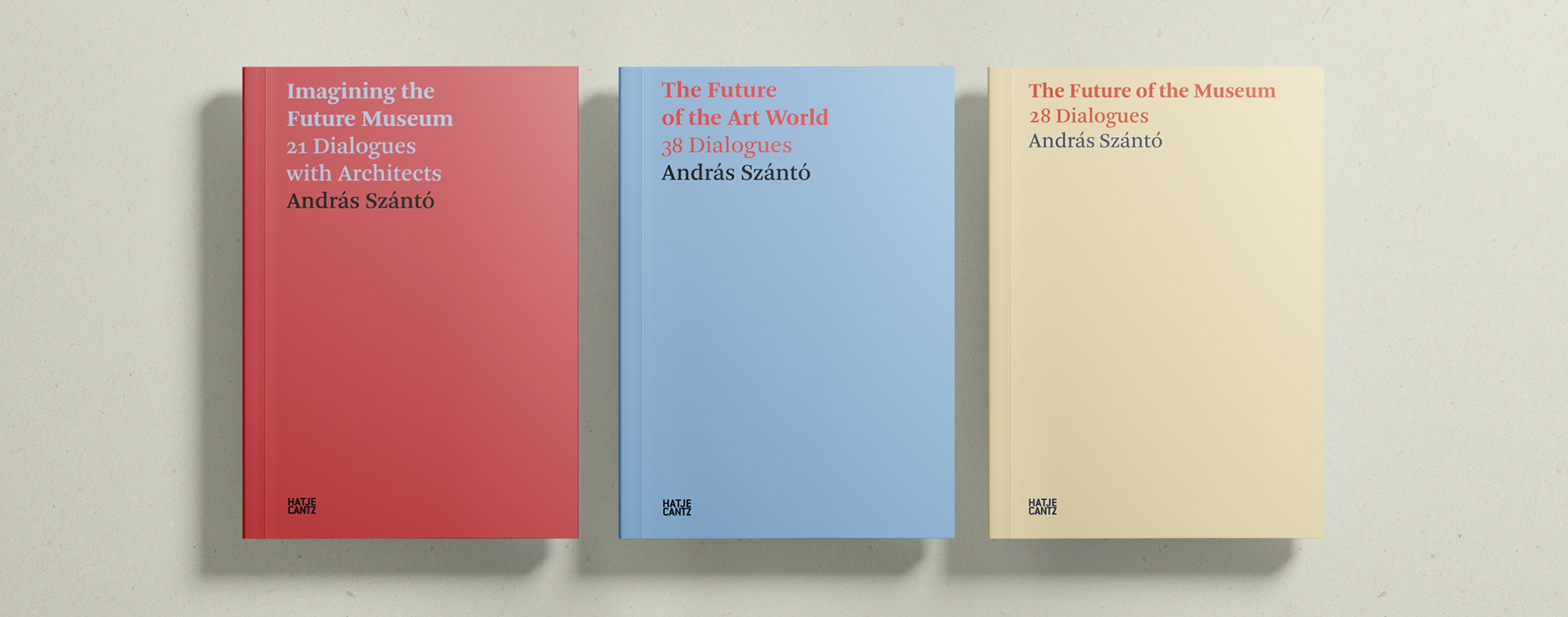
From left to right: András Szántó, Imagining the Future Museum: 21 Dialogues with Architects. Hatje Cantz, Berlin, 2022; András Szántó, The Future of the Art World: 38 Dialogues. Hatje Cantz, Berlin, 2025; András Szántó, The Future of the Museum: 28 Dialogues. Hatje Cantz, Berlin, 2020. Photo courtesy of the author.
[5] Szántó András, From Bark to Snark: Arts Journalism Seeks Its Way in the Twenty-First Century. Journal of the Clark 16 (2015), 40–45.
[6] András Szántó, Introduction: An Inventory of Conceivable Futures. In. Szántó 2025, 8–25.
[7] Szántó 2025, 15.
[8] Szántó 2025, 17.
[9] András Szántó, The Future of the Museum: 28 Dialogues. Hatje Cantz, Berlin, 2020. 10.
[10] Sam Kriss, Prophecies for 2026. Isn’t there something deeply extravagant about stupidity? Numb at the Lodge (Substack):https://samkriss.substack.com/p/prophecies-for-2026.
[11] Szántó 2025, 183.
[12] Szántó 2025, 159, and Szántó 2020, 14.
[13] To further understand how certain countries, such as Hungary, seem to fall out of the scope of the art world – a phenomenon Szántó hints at several times during the interviews – see Kristóf Nagy’s article Egy globális művészeti mező felé? Larissa Buchholz The Global Rules of Art című kötetéről [Towards a Global Art Field: On Larissa Buchholz’s book The Global Rules of Art] on Exindex.hu: https://exindex.hu/hu/kritika/egy-globalis-muveszeti-mezo-fele/.
Szántó’s core tenets, presented in the book’s sizzling introduction – in blurbified essence – run roughly as follows: while the art world mutates – adapting to demographic shifts, a hard reset of globalisation ideals, and the rise of an experience economy – the quasi-colonial white cube and its inhabitant, the well-lit art object, are falling into decline. Gatekeepers and middlemen – galleries among them – now play with a reshuffled deck, where wildcards such as AI, the waning bite of criticism[5], and the blandness-inducing hypermarketification of culture might yet pull an “Uno Reverse” on us.[6] Thus, “reinvention is not optional”[7]; the question, rather – to borrow the rhetoric of American election campaigns – is whether the art world is yearning for incremental reform or a paradigm shift.[8] Yet merely surviving (or simply getting by) feels like a reasonable goal these days, making a gentle glide into an unchanging future seem, perhaps, the safest bet. But the lingering question remains: is the cultural stasis Mark Fisher identified truly escapable?
In methodological terms, the interview format Szántó relies on – juxtaposing highly personalised questioning with well-crafted hypotheses – hints at a data analyst’s precision.[9] With certain recurring focal points, one gets the sense that the author-sociologist is assembling material for later analysis, effectively embedding a structured questionnaire within the fluidity of free-form discussion. Szántó refrains from taking jabs at his would-be prophets; unlike the narrator in Frank Zappa’s 1972 song Cosmik Debris, who aggressively challenges the caricature of the soothsayer (“Look here, brother / Who you jivin’ with that cosmic debris?”), he maintains a respectful distance. To be fair, some interlocutors seem hesitant to engage in futurological thought experiments, a stance Szántó readily accepts: the present is already elusive enough, and speculation is not everyone’s cup of tea. And who can blame them? As Substack writer Sam Kriss observes of “the holy curse of prophecy,” the challenge is no longer prediction itself but the near-impossible task of isolating “…the one voice saying something interesting in an entire football stadium of people whispering nonsense.”[10] Szántó succeeds precisely because he excels at identifying and bringing together these rare, intriguing perspectives.
Szántó’s method mirrors the way discourse evolves in the podcast sphere: long-format discussions with a rotating range of guests, where the host’s positions are revisited and fine-tuned over time. Szántó has several issues he is particularly eager to explore: the museum’s role in future imaginaries; the gallery as a creative hub; art fairs as agents of change; and the inequalities between players (“cut the middleman!”[11]; “get off the high horse!”[12]). He explores the restaging of the artist as an institutional protagonist, the mismatch between the legacy art world and its inhabitants, and the uneasy love affair between professionalisation and homogenisation. As a disciple of Arthur C. Danto, Szántó is especially keen to map adjacent terms – from Pierre Bourdieu’s “art field” and Howard Becker’s “art worlds” to Joshua Citarella’s distinction between the “lowercase-a” and “capital-A” art world. This deep dive, anchored by a brilliant interview with Larissa Buchholz, delivers what Szántó is always after: a higher-definition intellectual map.[13] After all, isn’t the art world a kind of lore – a great example of world-building? And if so, why shouldn’t we learn to speak its Elven tongue, its lingo, its “International Disco Latin” (Hito Steyerl) properly? Perhaps artspeak itself is the generative code on which this world runs.
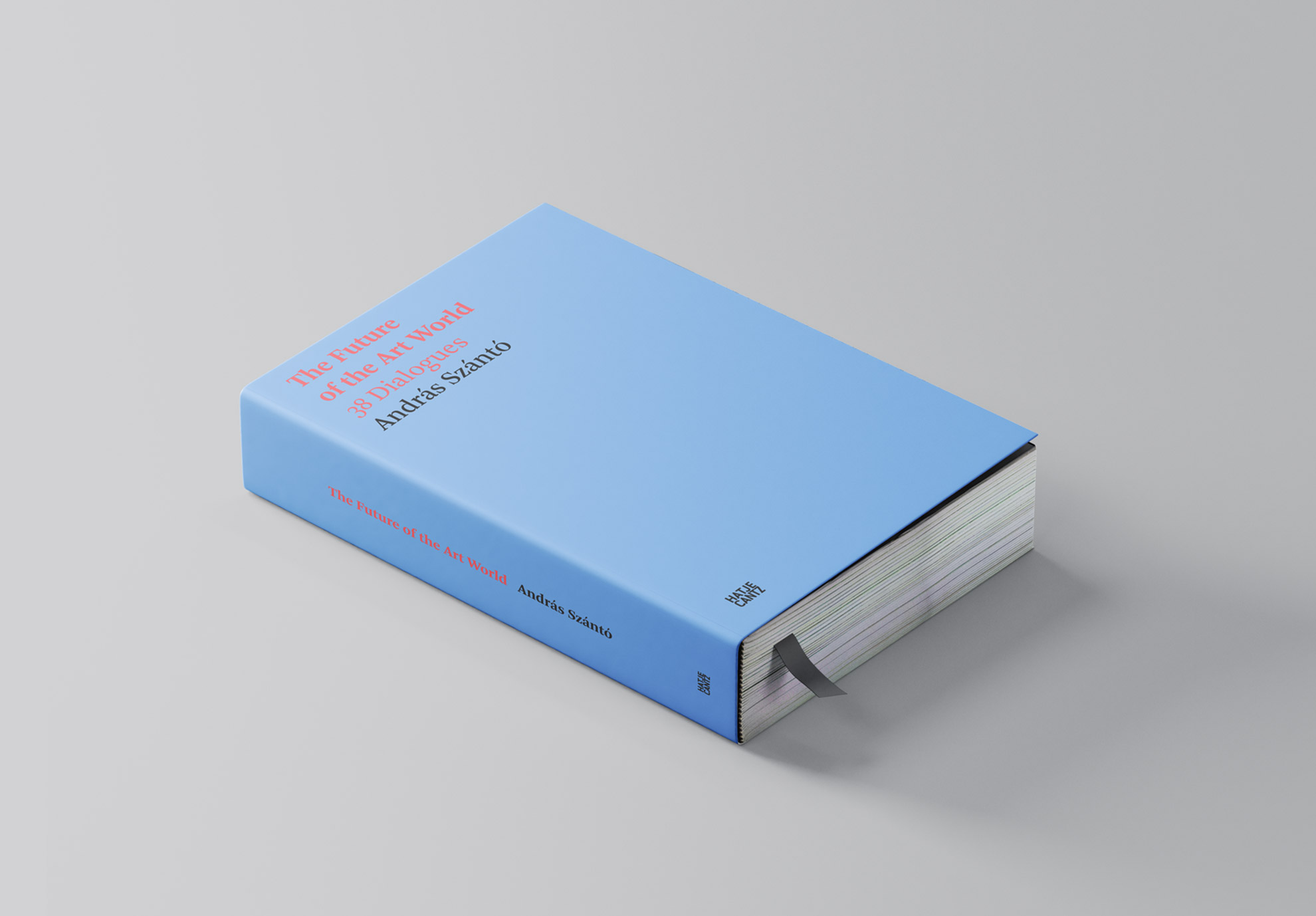
András Szántó: The Future of the Art World: 38 Dialogues. Hatje Cantz, Berlin, 2025.
Photo courtesy of the author
[14] For example, Szántó 2025, 402.
[15]Szántó 2025, 85.
While reading the interviews, many resonate instantly: the mixture of verve, critical acuity and an informed viewpoint proves to be a well-balanced recipe. Take Marcello Dantas’s poetic meditations on the urgency of rewilding the art world, the stunning clarity Ophelia Deroy brings to the weary tropes of well-being, or José Kuri’s fresh insistence that relationships, not real estate, form the foundations of galleries. While each interview is a highly informative venture, not all propel the book’s central questions with the same velocity. Szántó, however, consistently maintains a sharp, gentlemanly presence, eliciting unexpected angles and witty comebacks while effortlessly evoking ’90s classics like Jurassic Park and Terminator alongside further hyperbolic associations. The inherent tension of the interview format lies in how it replaces the messy business of prolonged rumination with the fresh spark of intricate improvisation and eloquence; here, editing becomes the true platform for slowly-emerging critical thought. Some of the book’s most refreshing moments, however, arise when our “art-world detective” pushes back against his interlocutors[14], and it is equally delightful when, for instance, Szántó nudges Joshua Citarella toward a less doomerish prognosis: “Okay, let’s hear the utopia, because I’m getting nervous.”[15]
As we sift through the interviews for those “textual nuggets” – the one-liners usually blown up in extra-chic, lavish typeface across glossy magazine spreads – we engage with the materiality of language and language as an editorial object: intricate, personal modes of thinking and the game of dialogue itself. To curb our appetite, each in-depth discussion is headed by a typographic, concrete-poem-like “sentence-image” from the interviewee: “The art world has become more and more about moments” (Calum Sutton), “What you are selling is magic” (Marc Spiegler), “A great gallery can be the size of a bathroom” (José Kuri). Some would serve as perfect examples of the editorial extractivism through which criticism distils its own aphoristic essence (for a primer on this emphasis on “textual rizz,” see the edgy social media output of platforms such as Spike Art Magazine). Yet Szántó never lets this editorial device tip into outright sensationalism, ultimately opting for pragmatic, no-nonsense titles instead.
The Future of the Art World doesn’t so much predict what’s coming as rehearse our collective unease about the future. Szántó’s strength lies in calibration – tuning the noise and mapping the field. What he offers is a coffee-or-cigarette break from the screeching, tumultuous present: a moment spent leaning against a wall, smoke curling or espresso cooling, where ideas about the “workplace” – the museum, the art school, the gallery – can be traded just outside their looming jurisdiction. The future, here, is an ongoing conversation – and one still worth showing up for.