Polyphony. An exhibition of the Bratislava-based Art Fond collection in Budapest
Ludwig Museum, Budapest, 24 April – 20 September 2026
Gábor Ébli
Andrej Zaťko, a businessman with a degree in engineering, has been working in the financial sector for nearly thirty years. Today, he is a co-owner and director of 365.bank. The art collection, which has been growing for over ten years and features works by internationally renowned artists such as Maria Bartuszová (1936–1996) and Milan Knížák (1940), began as the bank’s collection, was subsequently purchased by him, and is now being further developed as a non-profit collection under the name Art Fond.
Stano Filko: Altar of contemporaneity ╱ 1960-1962
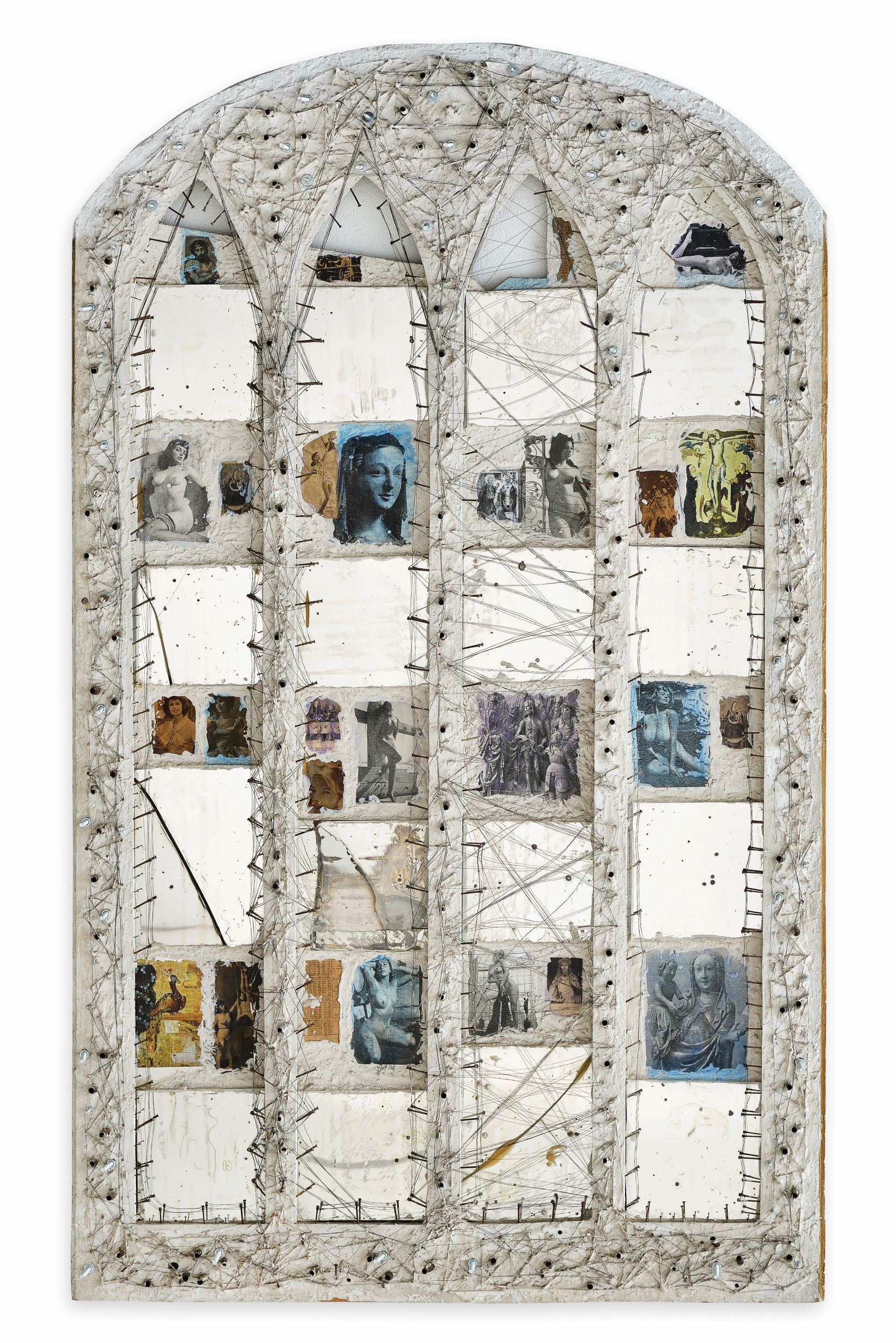
Stano Filko: Altar of contemporaneity ╱ 1960-1962
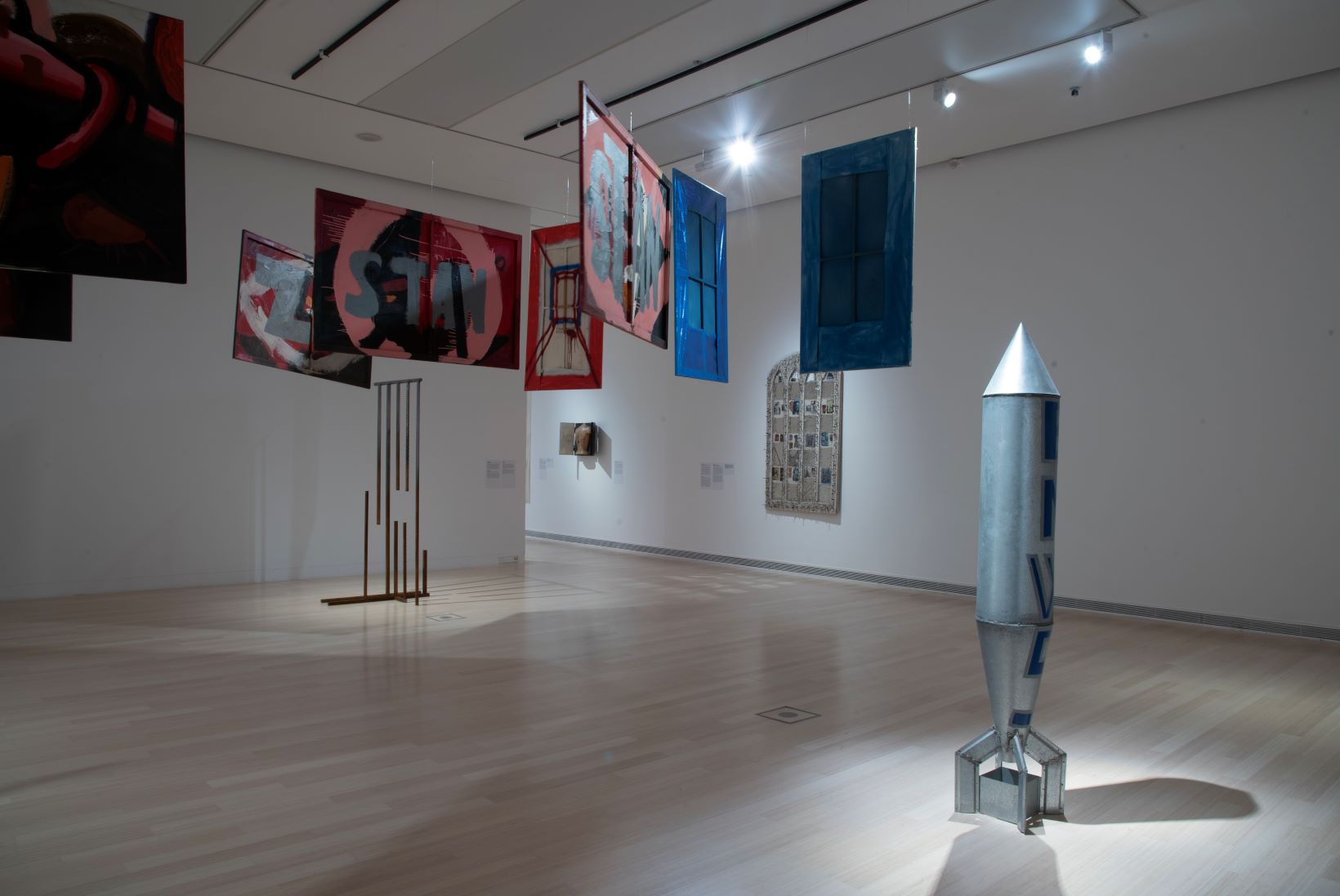
Stano Filko: exhibition view
Icon image: Juraj Melis: Idioteka humanitatis ╱ 1976
Cover image: Alex Mlynarcik: Permanent manifestation – Lola ╱ 1966 ╱ exhibition view with the artist’s two monotypes to the left
From the outset, art historians have formed the advisory board, including Katarína Bajcurová, one of the curators of the current exhibition. In a separate section of the collector’s home, another selection curated by Lucia Gregorová Stach, the other curator of the current exhibition, will be on view by appointment. Both experts previously worked at the Slovak National Gallery, but amid political tensions, they were forced to move to the Art Research Centre of the Slovak Academy of Sciences, which has thus become the professional partner of the exhibition at the Ludwig Museum.
The Budapest exhibition features roughly one-fifth of the collection. The remaining works also reflect a selection similar to the current exhibition, drawn from the Slovak, Czech and Czechoslovak experimental movements of the past half-century, as well as those reflecting on social themes. Historically, this can be divided into two periods: the period between 1968 and 1989, following the Prague Spring, characterised by state-party rule based on political repression; and the decades since the political transition and the establishment of the two independent states.
In 2020, a smaller exhibition was organised in Bratislava from the collection then known as the Central European Contemporary Art Fund, curated by Beata Jablonská and Kristína Jarošová (an art specialist trained in Bratislava and London, the collector’s wife at the time and co-founder of the collection).1 The collection’s 2024 e-catalogue is available, and a printed version can be purchased at the Ludwig Museum bookshop.2
Both the collection and the current exhibition treat neo-avant-garde and contemporary material as a unified whole. There is no chronological arrangement, no pairings, no references to which contemporary artist drew inspiration from the specific position of the earlier ‘great generation’. Classic contemporary and young art appear interwoven, just as the artistic developments of the two countries – which were once one and then split – are presented jointly. The intention to expand the collection regionally remains.
Roman Ondák: Unauthorized access prohibited ╱ 2015
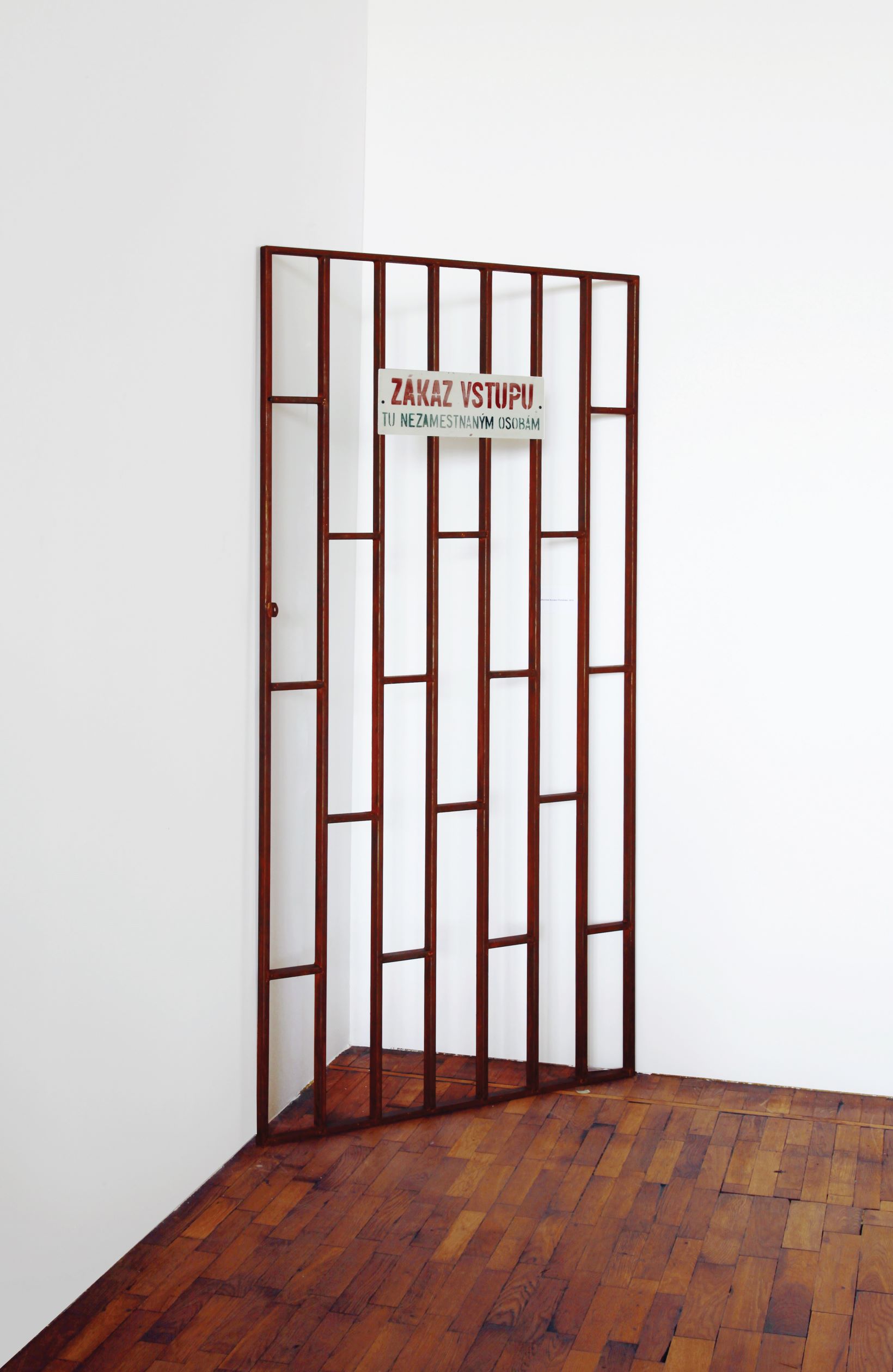
Roman Ondák: Unauthorized access prohibited ╱ 2015
In addition to its non-chronological and non-national focus, the collection and the exhibition are characterised by a likewise synthetic approach to genres. As the collection has been curated by art historians from the outset – who enjoy the owner’s free rein as much as his identifying with the works, having lived alongside them – a (post)conceptual impulse is dominant in the majority of the works; a visually driven approach to painting is rare, whilst within the experimental field, every genre is represented, from minimalist-philosophical works on paper that challenge the definitions of art, through contemporary embroidery, to digital NFT works
The use of photography is widespread. Of the forty artists featured in the exhibition – from Juraj Bartusz (1933–2025) to Karel Malich (1924–2019) and Peter Roller (1948) – none are photographers, yet from Michal Kern’s (1938–1994) Tatra land art works to Jana Želibská’s (1941) female figure montaged into an image of the same gravel bed depicting three different seasons, all set in a natural environment, a third of the artists employ photographic techniques.
This interplay between genres is also evident in the fact that the exhibition, divided into some ten sections (and two separate video rooms) by spaces of varying sizes, showcases numerous artists through a variety of works employing different techniques.
Stano Filko (1937–2015) is represented in the same space by an assemblage from his early period and, from his later New York period, by canvases suspended from the ceiling in a cleverly conceived arrangement. The early work, titled The Altar of Contemporaneity and created in the mid-1960s, was originally part of a larger installation and awkwardly places some twenty-odd photographs within a shared frame. The photographs, cut out from period printed materials, represent two diametrically opposed worlds. The defining topoi of Christian art, spanning centuries, clash with the erotic imagery of modern mass culture. Two types of iconography line the altar: the tradition seeking transcendence beyond worldly pleasures, and the earthly desire living in the present, worshipping the alluring female form. In some photographs, these two worldviews converge when a voluptuous female nude, in a profane gesture, is placed in the context of a crucifixion. Filko has mounted the iconostasis, arranged within columns reminiscent of Gothic cathedrals, onto a raw frame. The frame is held together by makeshift screws, nails, empty cartridges and rough wiring. The two worlds cannot be organically reconciled; only in this way, by force. The deliberately DIY-style, nearly two-metre-tall panel also alludes to the DIY culture of 1960s Eastern Europe and the everyday struggle between spiritual and material values.
Martin Gerboc: Das Reich (Golden age of grotesque) ╱ 2010-2015
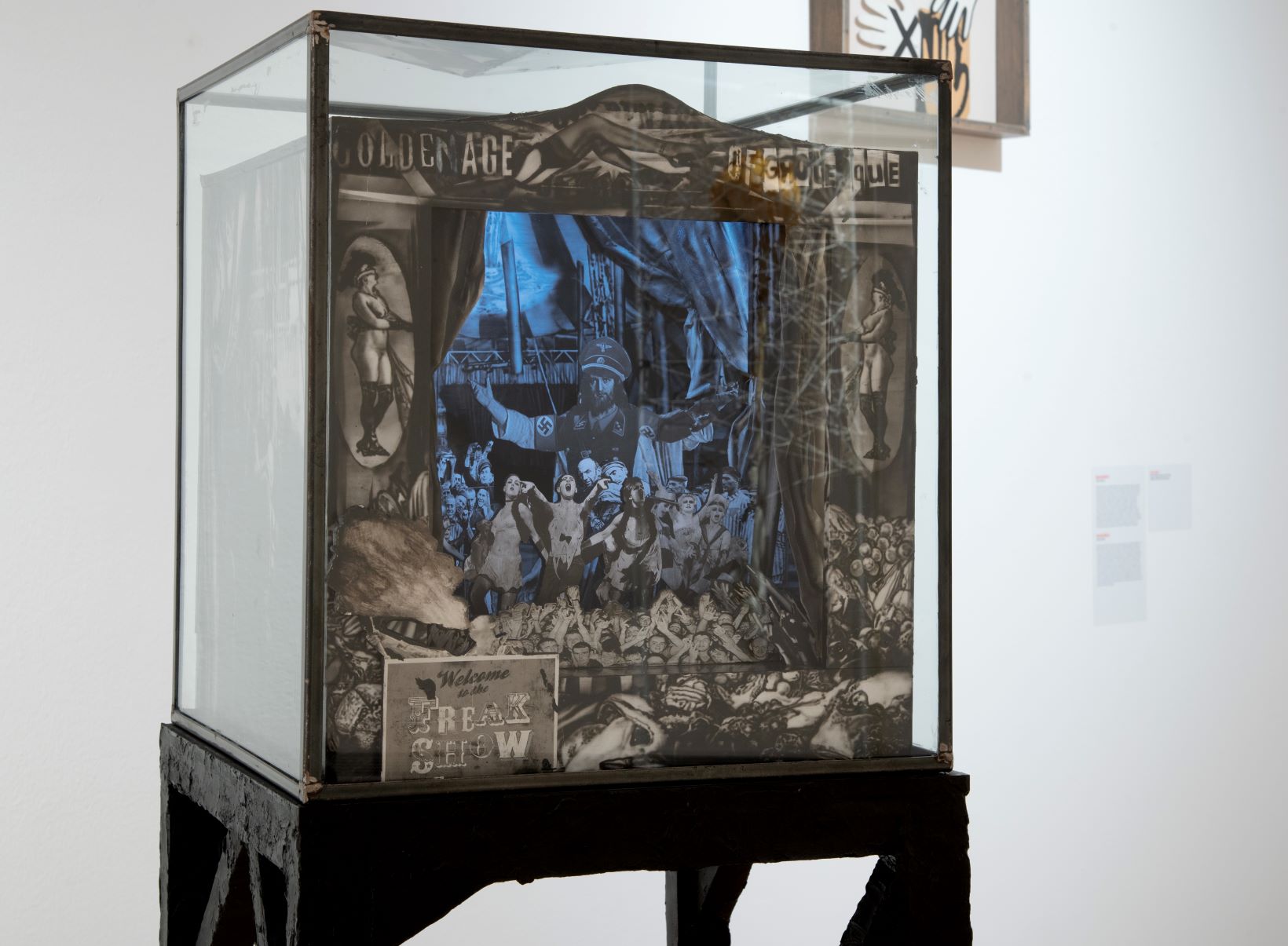
Martin Gerboc: Das Reich (Golden age of grotesque) ╱ 2010-2015
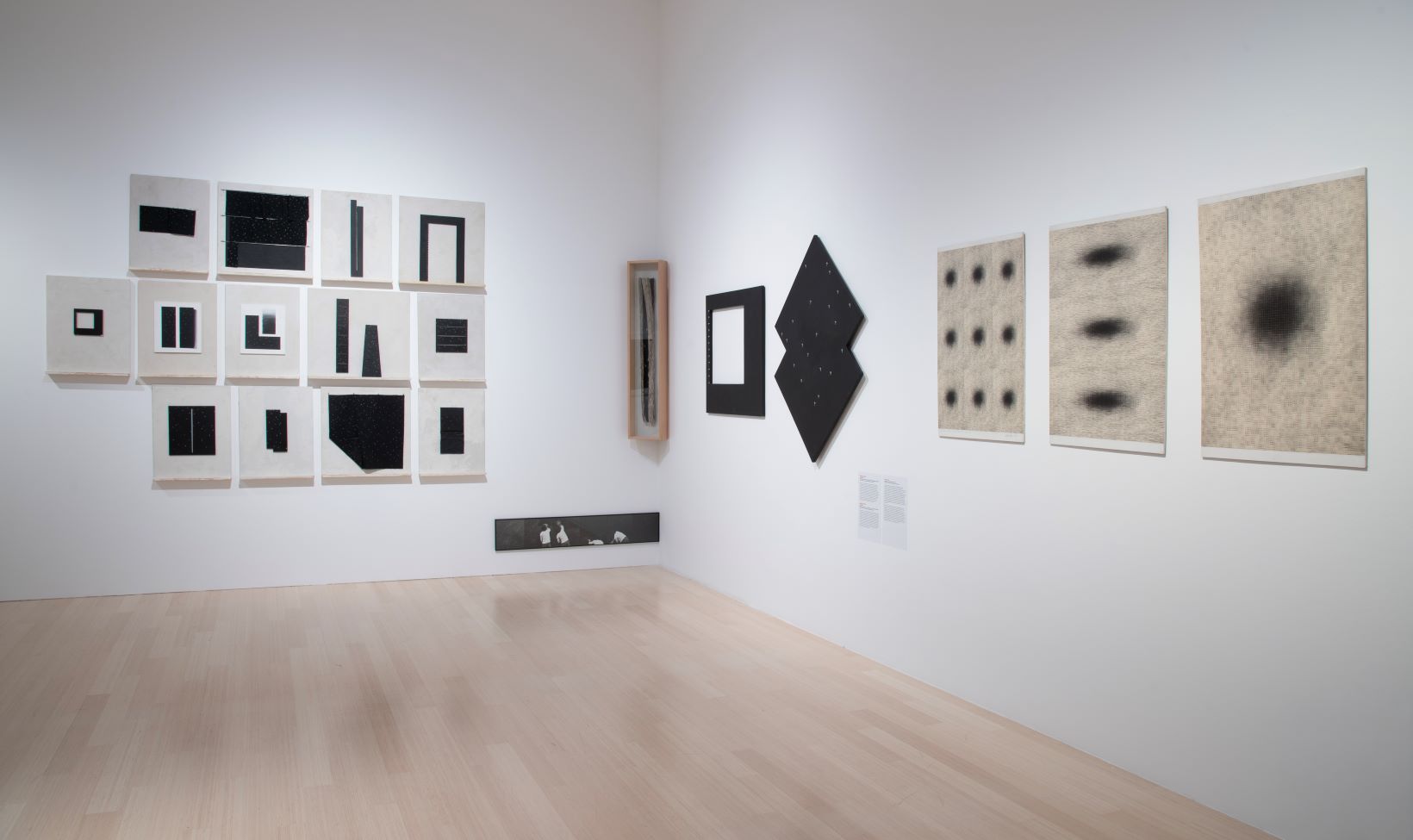
Monogramista DT (Dezider Toth): from the cycle KOANS ╱ 1977 ╱ exhibition view, on opposite wall
Július Koller (1939–2007) is also associated with various concepts of art and is represented here with works created across three different decades. He transformed everyday objects, including sports equipment, into works of art through unique interventions; at other times, he elevated by-products of painting, such as rags, to the status of exhibition pieces. Both of his programmes were a fitting homage to Marcel Duchamp, half a century after the latter’s recontextualising move in 1917. Koller’s smallest works, of the third type, simultaneously encapsulate these theoretical and socially sensitive, highly topical aspects of his thinking. From the mid-1960s, he produced visual calling cards and stamp prints on simple, toy printing presses, combining photographs with his own aphoristic, short, incisive texts, as demonstrated by UmeNIE, in 1972, a pun of grave political significance.
Martin Gerboc (1971) is an internationally acclaimed painter of today’s middle generation. On display is a work in the form of a painting, alongside a spatial fantasy constructed from a collage of cut-out photographs. He is repeatedly drawn to the worlds of revue, cabaret and theatre, and here we see a grotesque stage constructed from paper and saturated with photographs. A key element of his historical perspective is his interpretation of Germany’s drift towards fascism; thus, the space is populated by Hitler’s soldiers cut from contemporary photographs, prisoners of the death camps, and female dancers. The piece entitled The Reich reflects and superimposes the dual face of the power that emerged a hundred years ago: destructive, raw force and the release of brutality through physical pleasure.
Roman Ondak (1966) also features with a body of work combining various modes of expression. Through his installation, which includes photographic works, he imbues a cold, industrial door bearing a No Entry sign with new meaning. The staging highlights the thematic connection with a striking touch. The curators have placed the photographs at foot level on the wall. Rather than just bending down, one must kneel to view the photographic works. We may regard these as footnotes to the central core of the collection of objects, the ‘object’, just as we may interpret the act of bending down – the forcing of the voyeur’s attention as they walk confidently amongst the works – as a thematic reference, since the theme of the photographs is social exclusion, forced solutions, such as a makeshift bed for the homeless cobbled together from cardboard on a public bench.
We see the same compositional approach in the series by Dezider Tóth (1947), who uses the pseudonym Monogramista T.D. In the 1970s, the artist created black-and-white reliefs to visually represent koans – unanswerable questions and paradoxical statements – known from Zen practice, and the movable image elements can always be rearranged into different installations. In this current exhibition, the ensemble filling an entire wall is accompanied by action photographs, displayed at eye level, which evoke the process of their creation. Framed as a single unit, they highlight not the documentation of the steps but the process as a whole.
Otis Laubert: Who does the child take after ╱ 2015
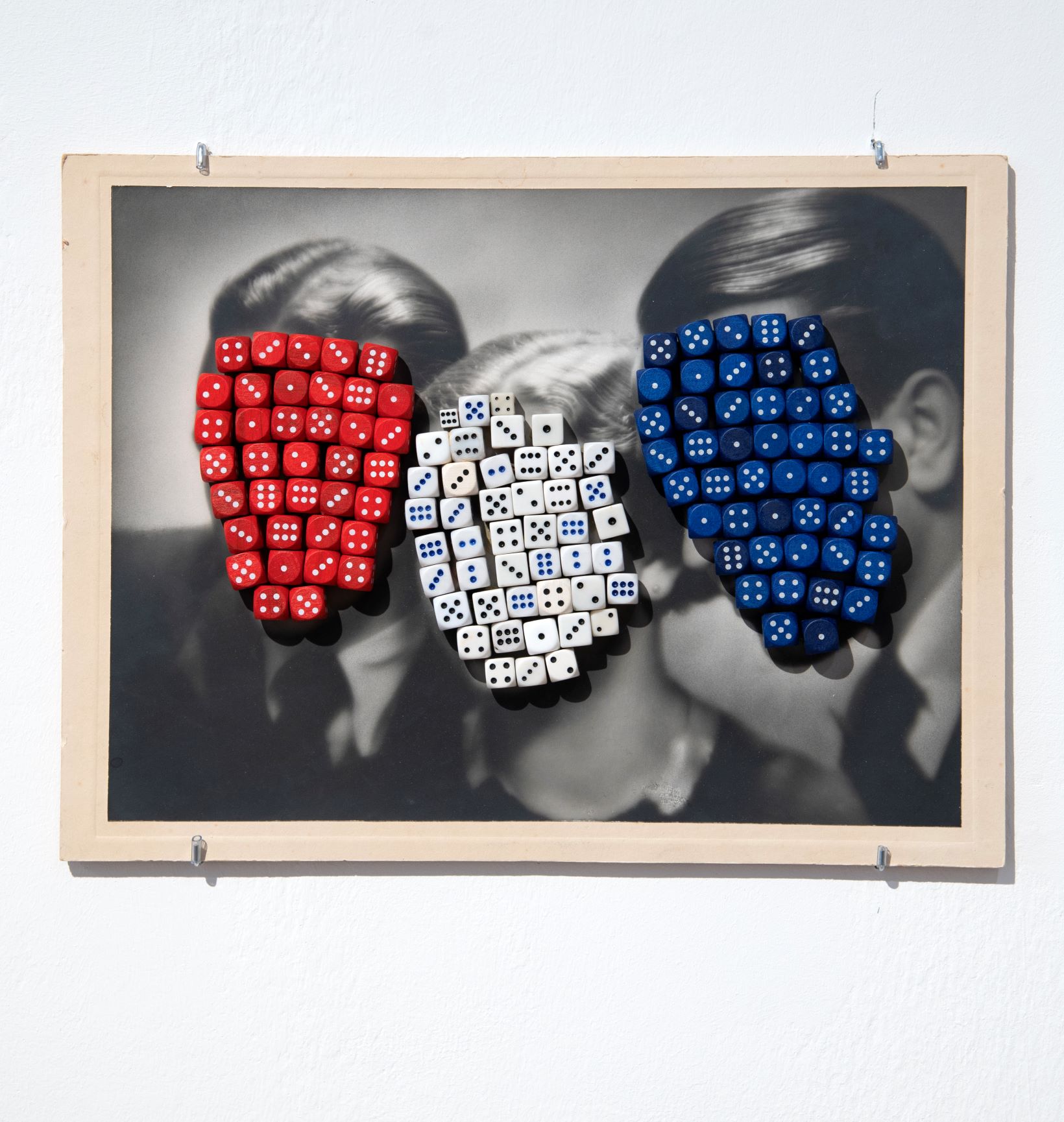
Otis Laubert: Who does the child take after ╱ 2015
Daniel Fischer (1950) explores the common ground between painting, photography and technical image-making. The exhibition features one tiny work and one enormous work displayed side by side. The starting point is the bison drawing in the Altamira Cave. The prehistoric artist can be regarded as a forerunner of today’s artists, as he did not merely depict the game to be hunted with mimetic intent, but conjured it onto the wall in a higher-order, ritualistic manner that interpreted the relationship between nature and humankind. If this was the case, we can certainly look beyond the animal’s details and seek the essence of the shaman-artist’s gesture. In the late 1970s, Fischer generated graphic symbols using computer tools; in the final step, he captured only the infinity symbol abstracted from the bison – the horizontal figure-eight – as the modern essence of an image dating back millennia. How can this realisation enrich contemporary art? He began using the motif on a scale of several metres as a painter. He then added further gestures around it onto the medium of his painting, the thin wooden panel. Behind the painting, against the backdrop of the infinity symbol, he placed a row of electric lights, which, in various colour versions, transforms it into a lightbox-like work. The work was presented in three lighting phases at the Czechoslovak Pavilion at the 1993 Venice Biennale.
Numerous other artists also combine a variety of techniques. Magdaléna Jetelová (1946) projects a laser onto the remaining ruins of Second World War bunkers in Denmark, then creates a real lightbox from the photographs taken of this. Rudolf Sikora (1946) also explores the hidden, ongoing legacy of the World War today, combining symbols associated with deportations with a map representing the contemporary Slovak state, and complementing the installation with bright neon light. This work also highlights the significance of the curators’ decisions. At the 2020 exhibition in Bratislava, it was arranged as described in the catalogue, thereby emphasising its historical message of confrontation, whilst here in Budapest it is displayed in a vertical arrangement, as an autonomous artistic symbol.
Alongside the historical theme, there is a recurring reflection on the nature of art and the question of what can become a work of art. Otis Laubert (1946) favours recycling found objects that others have already discarded, whilst Jaroslav Kyša (1981) uses a natural formation, a fossil, as the focal point of his installation. The issue of female roles is equally prominent in the exhibition. It was mentioned during the curatorial tour that the exhibition deliberately concludes with works by Denisa Lehocká (1971) and other feminist artists.
The very first room can also be seen as the exhibition’s conclusion. The series of rooms forms a sort of circle, bringing the visitor back to the starting room. And perhaps, at the end of the exhibition, they view the works they saw first in a different light. Kristián Németh’s installation, which synthesises photography and video, looks back at the collapse of a Renaissance sculpture at the Metropolitan Museum of Art in New York in 2002. It recreates the statue as a massive image composed of multiple panels – just as the museum decided to proceed with its restoration. What, then, do we regain at the end of a process that raises fundamental questions of heritage conservation? Németh’s project is open to both optimistic and critical interpretations. One might say that piecing together, or reconstructing any past, is always incomplete, merely an illusion. This is what the contemporary artist’s photo panel is intended to highlight: the statue from several hundred years ago is not homogeneous but divided into several panels. Yet one could also argue that the Renaissance itself was a rebirth of an (idealised) earlier past, and that the perception of the past in the present is always mosaic-like, constantly changing, continually reborn through reinterpretations. Wasn’t the neo-avant-garde a revival of the classical avant-garde? The present is always a fragmentary renaissance of some (perceived) past. In the end there will be no end – Németh gave this as the title of his work, referring to the unceasing process, the blurring of past and present. And the curators aptly chose this enigmatic phrase as the title for the entire exhibition.
Rudolf Sikora: Half-time of the breakdown ╱ 1994-2011

Rudolf Sikora: Half-time of the breakdown ╱ 1994-2011
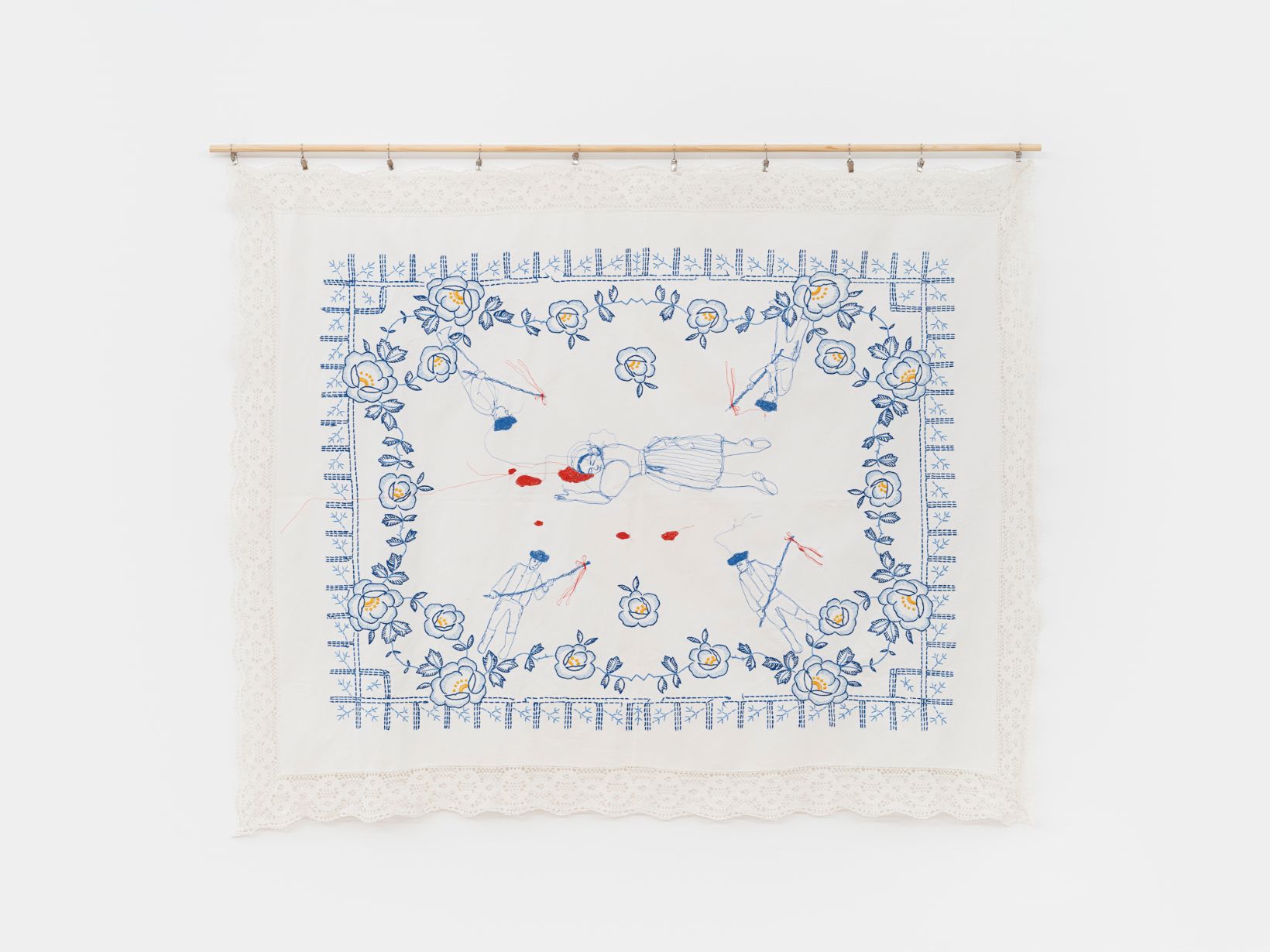
Ivana Šáteková: Easter whipping ╱ 2022