America, on the subject of cars.
A thematic selection of photographs from the collection of György Pálfi
Gábor Ébli
A steam locomotive gallops across the prairie. It pulls a long line of carriages, with a column of smoke rising from its chimney towards the sky; we can almost see the boiler devouring the coal. A road runs parallel to the railway track, with a car approaching us along it. Elliott Erwitt’s photograph, taken in Wyoming in 1954, shows two defining modes of transport of the modern age travelling in the same direction. They help to conquer endless distances, making the continent habitable. One embodies raw power, the other a more sophisticated technology.
Gregory Crewdson: Production Still, Mapple St. #2 ╱ 2003 ╱ archival pigment print ╱ 28 x 41 cm
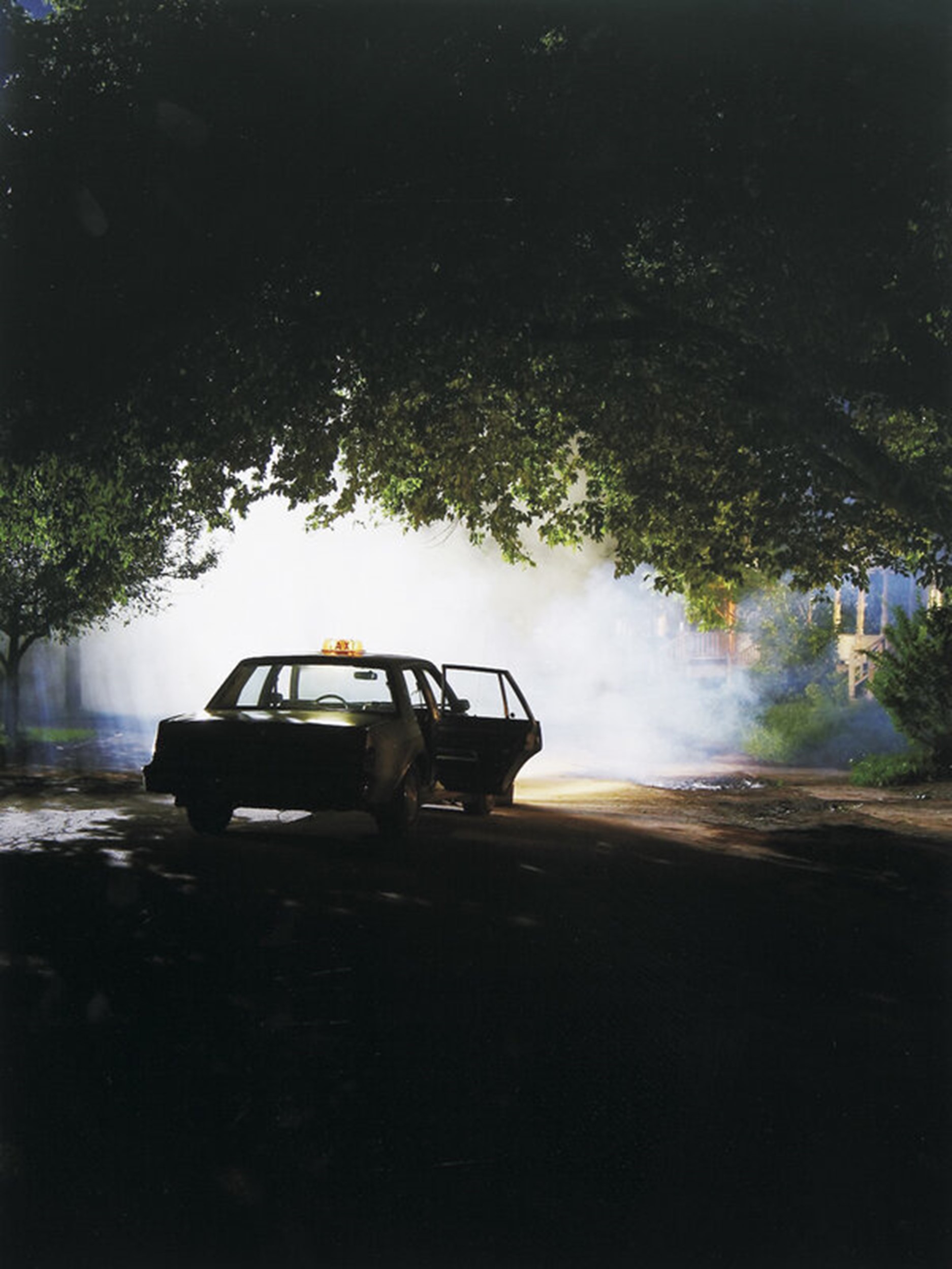
Gregory Crewdson: Production Still, Mapple St. #2 ╱ 2003 ╱ archival pigment print ╱ 28 x 41 cm
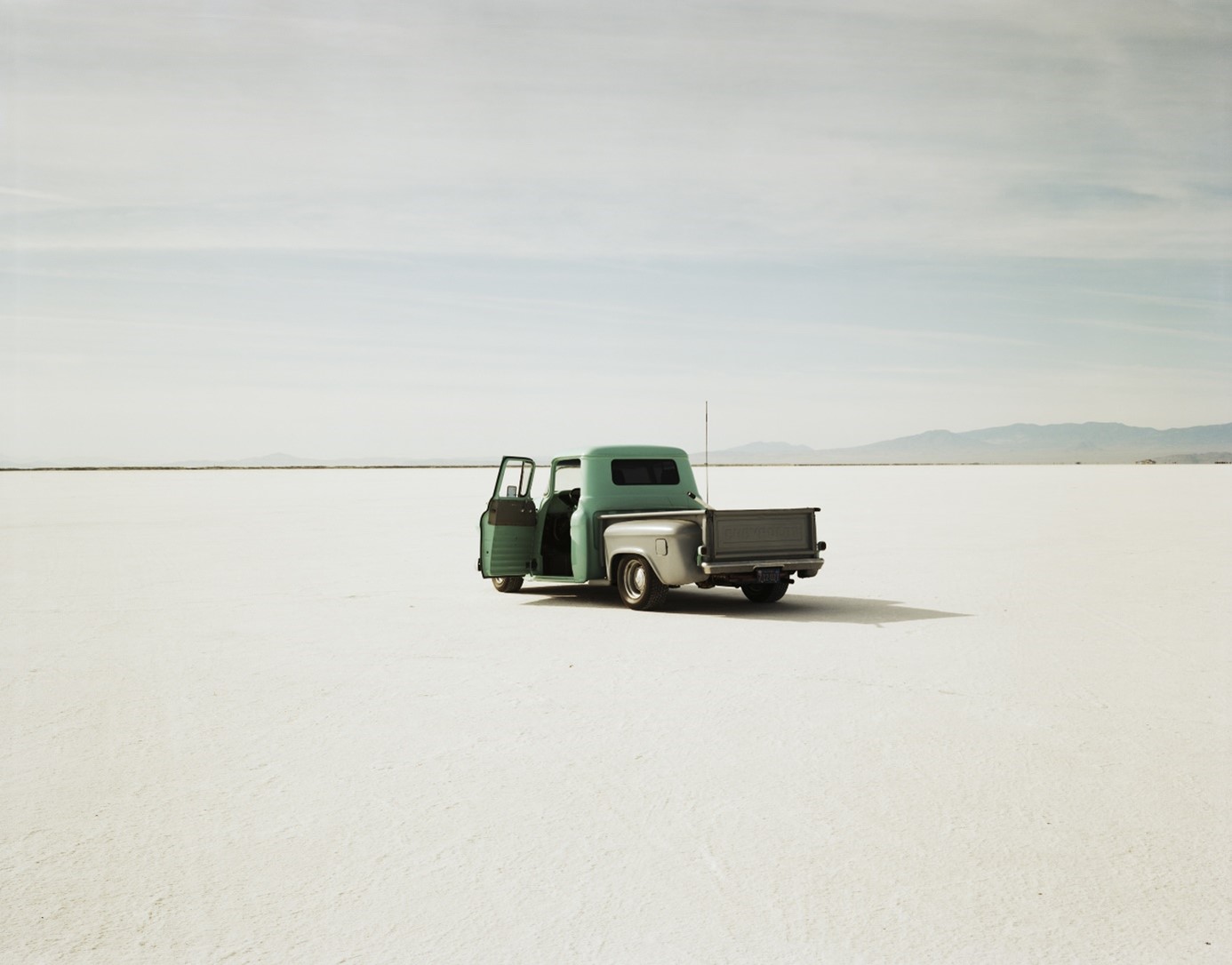
Richard Misrach: Pickup Truck, Bonneville Salt Flats ╱ 1992 ╱ archival pigment print ╱ 45,7 x 58,4 cm
Icon image: Joel Sternfeld: After a Flash Flood, Rancho Mirage, California ╱ 1979/1981 ╱ dye transfer print ╱ 40,5 x 51 cm
Cover image: Thomas Ruff: press++65.33 ╱ 2016 ╱ chromogenic print ╱ 30 x 37,6 cm
Both vehicles also appear in a photograph taken by O. Winston Link two years later in Virginia. On a summer night, the locomotive’s plume of steam glows white. An open-air cinema has been set up near the railway embankment, with dozens of cars parked in front of the screen. In one of the seats, a young couple embrace romantically. Here, the car is a vehicle that has brought the audience to the venue of entertainment; at the same time, it is a comfortable seat, a sofa, and for an hour or two, an intimate, temporary home from which to enjoy the film. And what, incidentally, is the image visible on the screen? A picture of an aeroplane. In the photograph, three modes of transport are thus linked together. Amidst the clattering of the train, leaning back in the car, we admire the image of the flying machine.
As motorisation spread, the roads became wider. In Ernst Haas’s photograph taken a decade and a half later, the legendary Route 66 in Albuquerque is already a multi-lane road. Neon signs flicker. In this evening shot taken after a fresh rain, the dark sky and the lights reflecting in the puddles form a visual fireworks display. Our gaze jumps between the myriad effects: the roadside guesthouse, the fast-food restaurant sign and the silhouettes of vehicles waiting at the red light.
A multi-lane road also provides the inspiration for Thomas Struth’s photograph taken in New York in 1978. The avenue is deserted; it is perhaps early morning, and the cars parked on both sides – and their owners – are asleep. One can see for miles along the dead-straight road; the street scene captures a momentary respite in the city’s traffic, lasting just a brief spell of the day.
The parked, sleeping vehicles have inspired others too. In the same year, Joel Meyerowitz captured a similar scene in Florida, where the lights of the night glisten on the metal body of a car parked in front of a motel. Inside, the driver sleeps; outside, the car stands on the street. Tom Blachford’s composition is similar, showing a Mercedes convertible resting in front of a family home on a palm-lined street in an affluent residential area of Palm Springs. The interplay of shadows lends the photograph an artistic quality, whilst the supermoon’s unique light creates a surreal nocturnal illumination, casting dark patches around the trees and the car.
Mitchell Funk: Colorful Street Art Reflected in Car ╱ 2020 ╱ archival pigment print ╱ 52,07 x 36,2 cm
Elliott Erwitt: Wyoming ╱ 1954 ╱ gelatin silver print ╱ 28 x 35,5 cm
Joel Meyerowitz: Christmas at Kennedy Airport ╱ 1968/2021 ╱ archival pigment print ╱ 50 x 60 cm
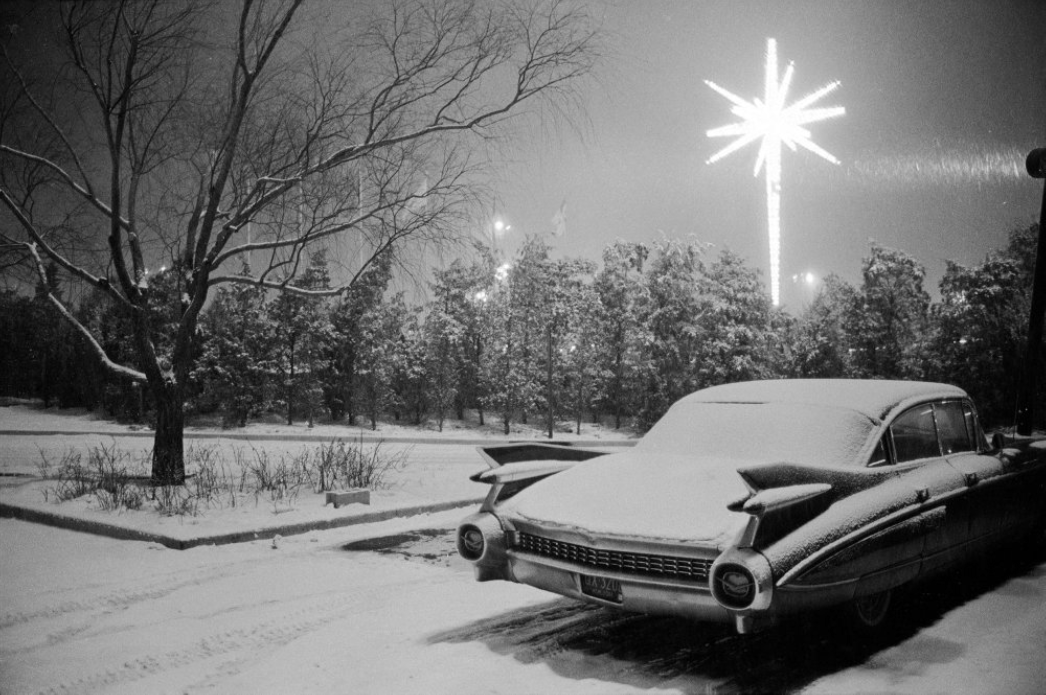
Joel Meyerowitz: Christmas at Kennedy Airport ╱ 1968/2021 ╱ archival pigment print ╱ 50 x 60 cm
Not every parked car’s surroundings look this safe. In contrast to the previous scenes, Jeff Brouws’s photograph from Montana shows not only storm clouds gathering in the sky, but also a white, elongated car parked enigmatically and alone near a roadside casino. Is its owner perhaps gambling inside, or might he eventually have to leave even the car keys behind as collateral?
Mystery also forms the basis of Mitch Epstein’s photograph. A limousine is parked at the edge of a multi-lane road on the now less orderly outskirts of New York’s financial district, not far from the site where Agnes Denes’s project Wheatfield – A Confrontation was realised. A figure lies on a camp bed on the unkempt roadside. The tension between the car, which exudes confidence – a premium-class Cadillac – and the vulnerable figure brings the image to life. Much like a still frame from a film, we might speculate whether the posh vehicle will drive on or stop to help.
William Eggleston captured a parking scene in Los Alamos in which the olive-green vehicle stands in front of a billboard advertising a new car. The dialogue between the real and the advertised cars drives the composition. The impact of the advertisement is amplified by the slogan, applied with a bold, playful flourish to the dark fence, which heralds the breakthrough of a new generation of cars.
During the same period, in the early 1970s, Stephen Shore captured that seemingly everyday scene in Florida, where a car dealership advertises luxury cars in huge letters and displays a few sleek, several-metre-long vehicles in front of the billboard for viewing. The image, dominated by the posh cars, the snow-white advertising space and the flooding sunlight, lends itself a healthy sense of dissonance: why were the cars parked on that tiny patch of green? It must have rained recently, as puddles sprawl across the driveway, also interspersed with the luxury vehicles.
A whole row of posh cars is parked in Evelyn Hofer’s photograph. The car park is situated on the roof of a New York building; the upper floors of the tower blocks are visible in the background, whilst the focus is on the design marvels resting side by side; their owners are no doubt attending to their business affairs nearby. These are not vehicles at all, but sculptures. A temporary open-air exhibition of the latest motorised sculptures right in the heart of the city. These cars were models from the so-called jet age: the prosperity of the 1950s encouraged manufacturers in Detroit and elsewhere to come up with bodywork reminiscent of the experience of flight.
Stephen Shore: West Palm Beach, Florida ╱ 1973 ╱ chromogenic print ╱ 20,3 × 25,4 cm
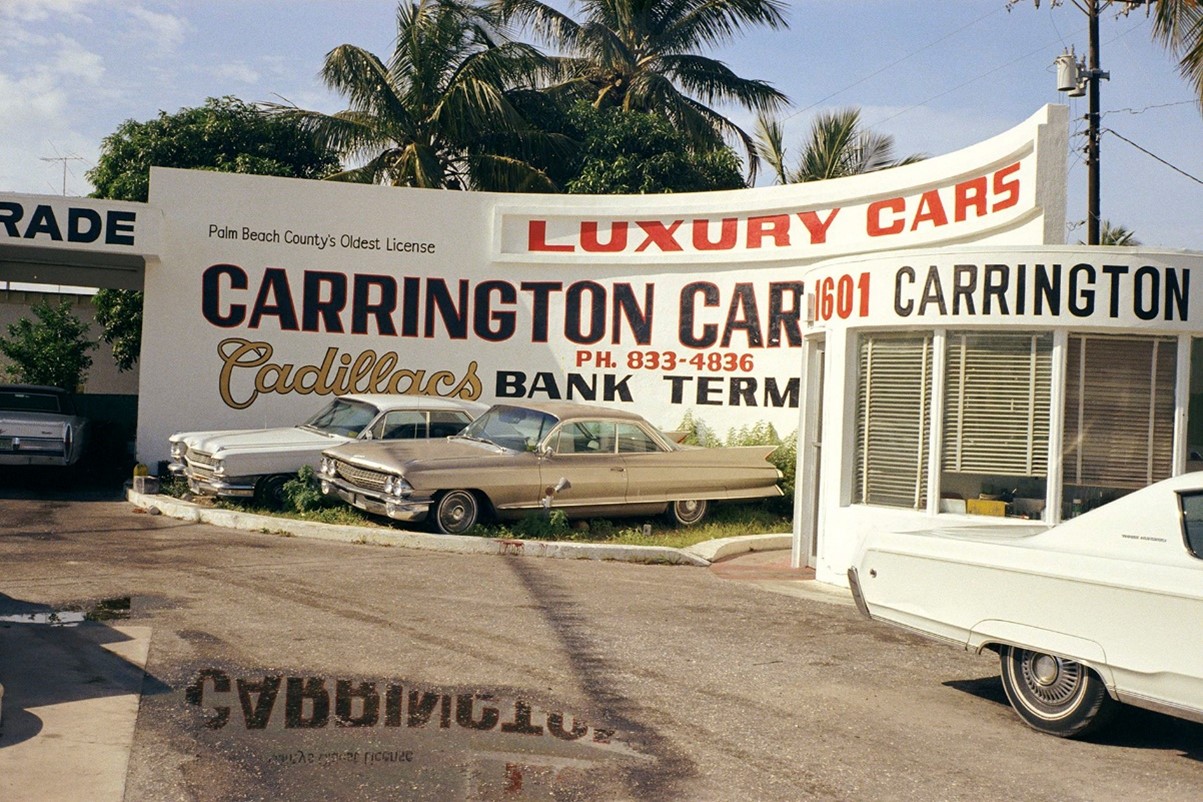
Stephen Shore: West Palm Beach, Florida ╱ 1973 ╱ chromogenic print ╱ 20,3 × 25,4 cm
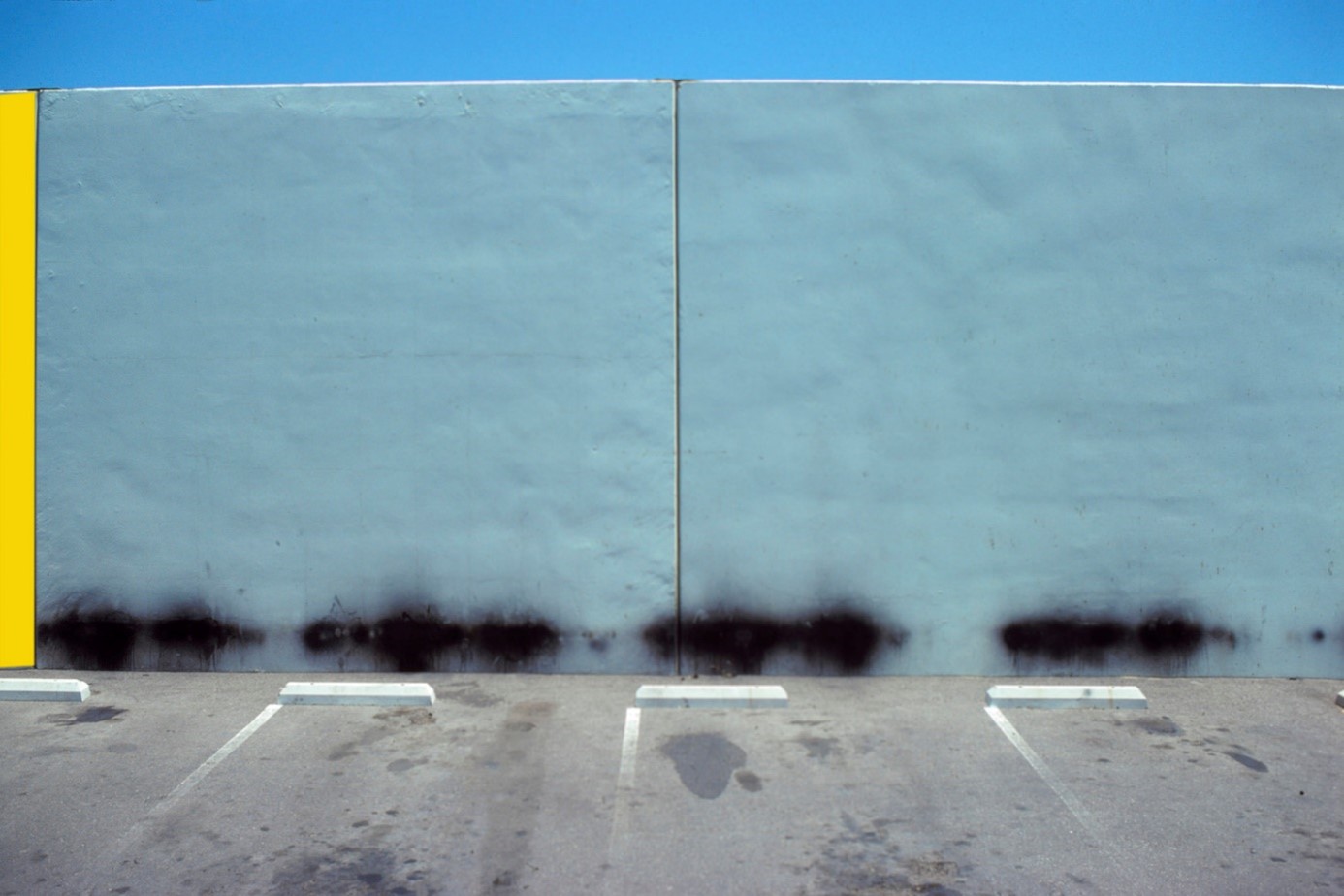
Grey Crawford: Chroma #06 ╱ 1979 ╱ archival pigment print ╱ 61 x 85 cm
The artistic quality of the cars is also essential in other photographs. Brett Weston focuses on a single detail of the vehicle. What we see is almost a close-up of a metal sculpture, with light glinting off the dust-free, polished metal surface. In Robert Funk’s photograph, colour also plays a central role, as the popular Beetle’s bright yellow body becomes a fetish, whilst a van appears dwarfed beside it in the clever composition.
Dynamic yellow also animates Robby Müller’s photograph, in which he multiplies the taxis waiting outside the New York Hilton in his 1986 Polaroid image. Langdon Clay contrasts the yellow body of a chequered taxi parked on a street in Lower Manhattan with the night lights spilling out from the buildings in the background. He also took the photograph of the police car model familiar from the Kojak films, dominated by the Plymouth Fury model with its bright blue paintwork.
Todd Hido adopts a different strategy to that of highlighting the details of a car; in his photograph, shrouded in a misty, fog-like atmosphere, a covered vehicle stands in the street. In the image, deliberately photographed against the street lighting, almost nothing of the surroundings can be made out; it is left to the viewer to make sense of the situation. A similarly covered vehicle stands at the foot of two palm trees in Robert Frank’s photograph taken in California. Perhaps the owner is protecting the vehicle out of sheer care; perhaps the image, fragmented by shadows, hints at some mystery.
The narrative interpretation is also open in Robert Misrach’s photograph: why is the pickup truck standing with its doors wide open in the middle of nowhere? Exposed to the natural environment on a snow-white surface due to the salt content, the vehicle appears waiting without its driver. If we add that the location is the legendary Bonneville Speedway in Utah, where races began in 1912 and a string of records were set over the decades, we can immediately interpret the temporarily abandoned vehicle in two ways: it could belong to a competitor or a spectator.
The relationship between the vehicle and nature also comes to the fore in Ernst Haas’s photograph from New Mexico; a storm is about to break. In the darkening landscape, a thin strip of sky still provides some light. The shot taken from inside the vehicle, captured in the rear-view mirror, also shows how the weather is colouring the landscape behind us.
Joel Sternfeld also positions the two vehicles in his photograph on a spectrum between the forces of the natural world and human-engineered design. The 1979 photograph from California shows a landslide following a flash flood, where one car has disappeared into the suddenly gaping chasm, whilst the other, the lucky one, escaped because there was (still) road beneath its wheels.
Robert Frank: Covered Car, Long Beach, CA ╱ 1955-56/1964 ╱ gelatin silver print ╱ 27,9 x 35,6 cm
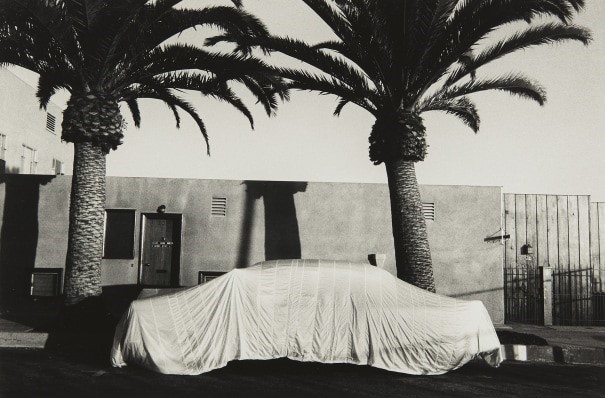
Robert Frank: Covered Car, Long Beach, CA ╱ 1955-56/1964 ╱ gelatin silver print ╱ 27,9 x 35,6 cm
1 https://www.maimano.hu/programok/kiallitas—americana—valogatas-palfi-gyorgy-fotogyujtemenyebol
Overall, this selection ranges from racing cars to the presidential limousine, telling a story of the American way of life through the lens of car culture. The collection was exhibited in 2025 at a leading centre for photographic art in Budapest.1 The collector, György Pálfi, has multiple connections to the motifs. He has been buying contemporary art since the 1990s, and photographs soon began to appear amongst the paintings and sculptures, as he has been drawn to photography since childhood. A thematic focus was also needed for the systematic collection of photographs, and this was provided by his travels to America. Through his work, he often travelled to the continent, and drove a great deal whilst there. He became increasingly familiar with the American world of motoring, evolving from an initial visitor to a participant who moved comfortably within that milieu. And after a few spontaneous purchases of photographs, the realisation dawned that here, at last, was the focus he had been seeking.
Within his broader fine art collection, he has thus compiled a selection of photographs over the past decade centred on the motif of passenger cars, not seeking mere depictions of them, but offering a glimpse into this slice of American culture and lifestyle. He has primarily included images devoid of human figures in the collection, which thus give the viewer the freedom to populate the scenes with stories and characters according to their own imagination. The material also documents the changes in photographic techniques and approaches over several decades. Most of the artists, from Ed Ruscha to Ray Metzker and Saul Leiter, are American. It was a deliberate intention that photographs taken from a local perspective should depict this world – but this did not preclude the inclusion in the collection of individual works from the series produced in America by György Lőrinczy in the late 1970s or by Gergely Szatmári after the turn of the millennium.
With five or six guiding principles, a coherent curatorial strategy was successfully established. The motif of the car, the messages of the American way of life, the structure of the compositions devoid of human figures, the predominantly American artists, the overview of the photographic medium from vintage analogue prints to today’s digitally manipulated prints, as well as the involvement of Marla Hamburg Kennedy, an expert with a deep understanding of both photography and the American art scene: these criteria have resulted in a collection that, following its current inaugural presentation, will hold its own wherever it is shown. Rather than any form of Eastern European self-pity, it serves as an example of how, through the targeted use of financial resources, persistent searching and consistent focus, a collection of international standing can be created even by a Hungarian collector.
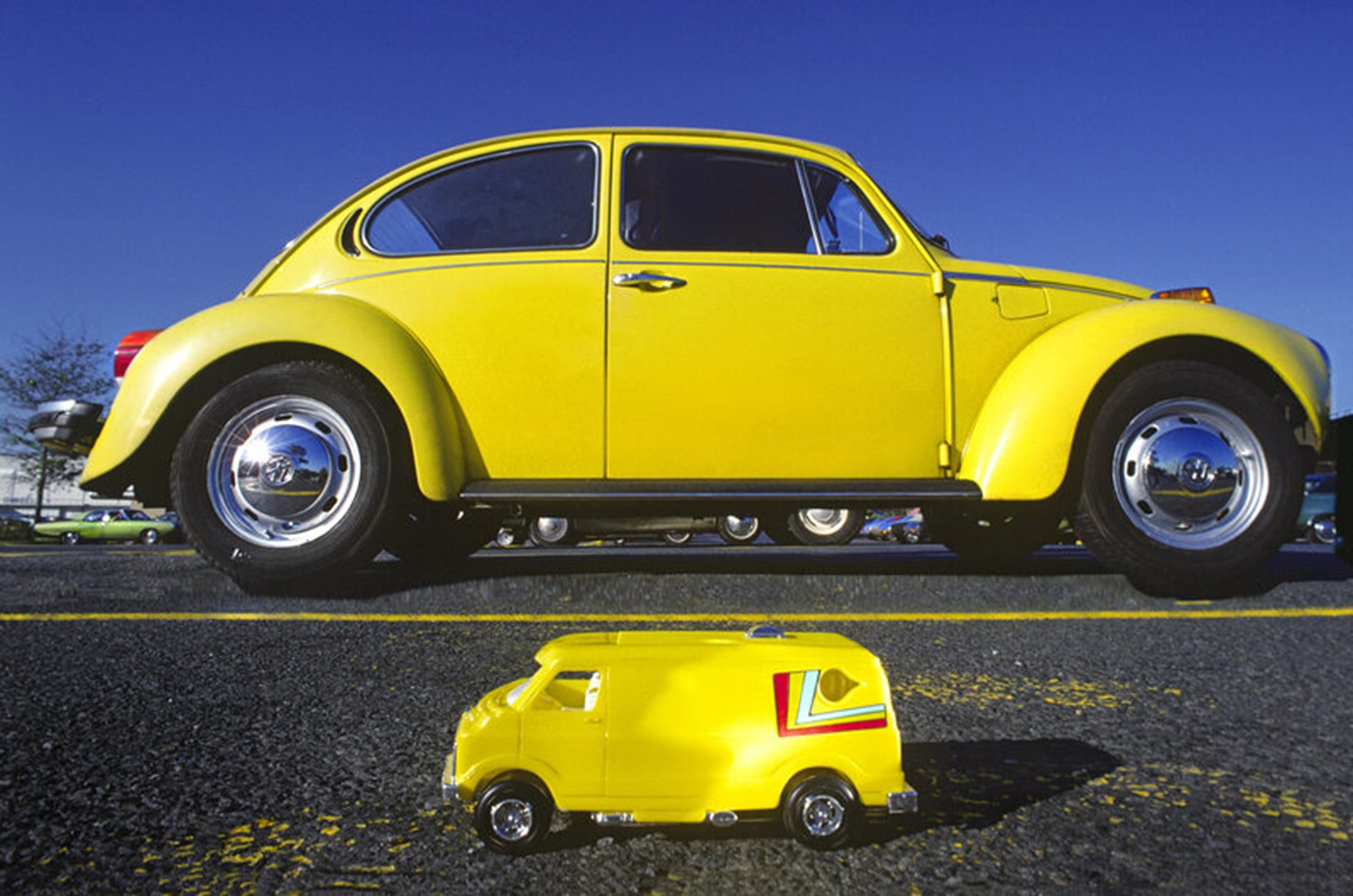
Robert Funk: Yellow Car Yellow Truck ╱ 1977/2024 ╱ archival pigment print ╱ 52,07 x 36,2 cm